Nigeria News
IG suspends wanted declaration against Obaigbena
Nigeria’s IG suspends wanted declaration against Nduka Obaigbena and eight others, moving the FirstBank threat probe to FID Abuja.

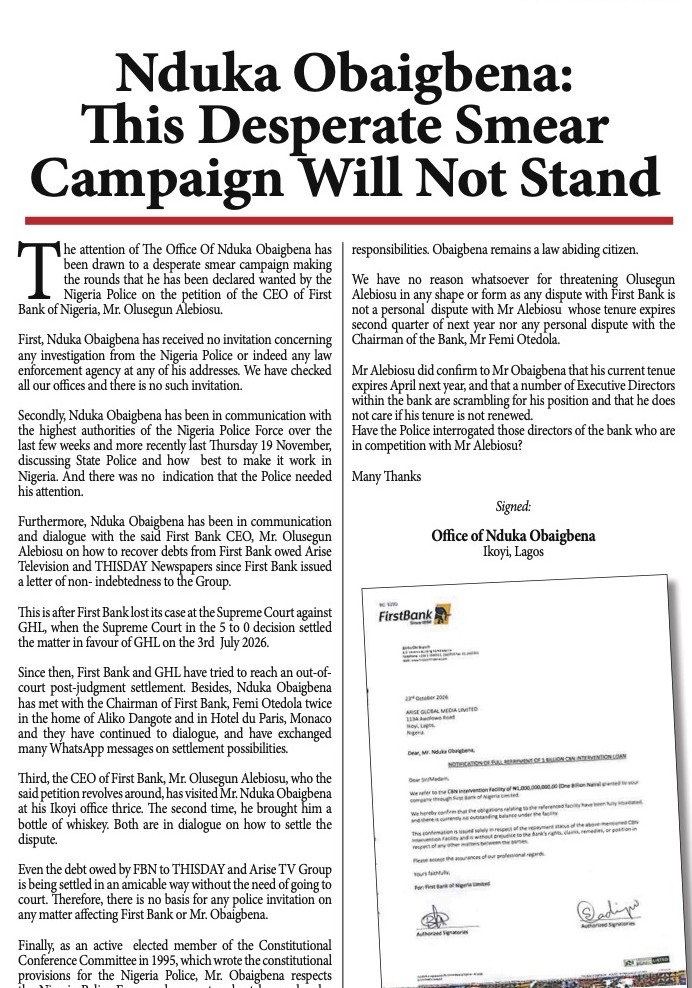
The Inspector-General of Police, Olatunji Disu, on Wednesday suspended the wanted declaration issued against nine business figures, among them THISDAY and ARISE News founder Nduka Obaigbena, less than a day after a subordinate commander announced it. That the IG suspends wanted declaration against Obaigbena and eight others at all is the substance of the story, not the list of names. It matters to Nigerian bank customers, borrowers and media owners because the case sits directly on top of a commercial debt dispute that briefly became a national manhunt.
The Force Public Relations Officer, CSP Ani Iniedu, said in a statement that Disu ordered the file moved from the Zone 2 Command to the Force Intelligence Department at the Nigeria Police Force Headquarters in Abuja, for what the police called a thorough and impartial investigation. All parties were directed to report at the FID between November 26 and 30, 2026. According to Leadership, the statement also directed that the wanted declaration be vitiated pending the final outcome of the investigation.
The nine named in the directive are Henry Kayode Ojogho of Broron Limited; Emmanuel Iheagwazi of Necit Nigeria Limited; Eze David of Energy Shield Petrochemical Limited; Tope Shonubi of Sahara Group; Ernest Azudialu-Obiejesi and Nnenna Azudialu-Obiejesi of Nestoil; Emmanuel Orim and Victoria Orim of Luzen Plaza; and Obaigbena of General Hydrocarbon Limited. The mix is notable. It runs from a media proprietor to the leadership of Nestoil, one of Nigeria’s largest indigenous engineering and energy contractors, and Sahara Group, a energy conglomerate with operations across West Africa.
The trigger, as PUNCH reported, was a parcel containing two rounds of 7.62mm live ammunition delivered to the Lagos residence of FirstBank Managing Director Olusegun Alebiosu. The parcel, presented as a fashion-design gift and carried by a dispatch rider whose identity was not established, was reported to the police on May 7, 2026, and opened the following morning. The ammunition is the type used in rifles including the AK-47.
The Assistant Inspector-General of Police in charge of Zone 2, Olohundare Jimoh, announced the wanted declaration on Tuesday at the Zone 2 headquarters in Onikan, Lagos. He said ten people were invited on November 5 to appear for questioning on November 12, and that only one honoured the invitation. Jimoh said preliminary findings suggested the threat could be connected to FirstBank’s loan recovery activity involving customers who allegedly owed the bank billions of naira.
How The IG Suspends Wanted Declaration Against Obaigbena, And Why The Reversal Counts
Two police formations published contradictory positions within roughly 24 hours. Zone 2 declared nine people wanted; Force headquarters said the declaration carries no legal force for now and moved the file to Abuja. THISDAY reported the IGP’s action as an overrule of the AIG’s decision.
What the police have not published is the specific alleged role of each of the nine. The public record establishes that invitations were issued and not honoured, as Jimoh stated, but it does not establish what any individual is accused of doing beyond that. Critics of the original declaration raised exactly this point, and the transfer to the FID is, in effect, an acknowledgement that the file needed a different handler.
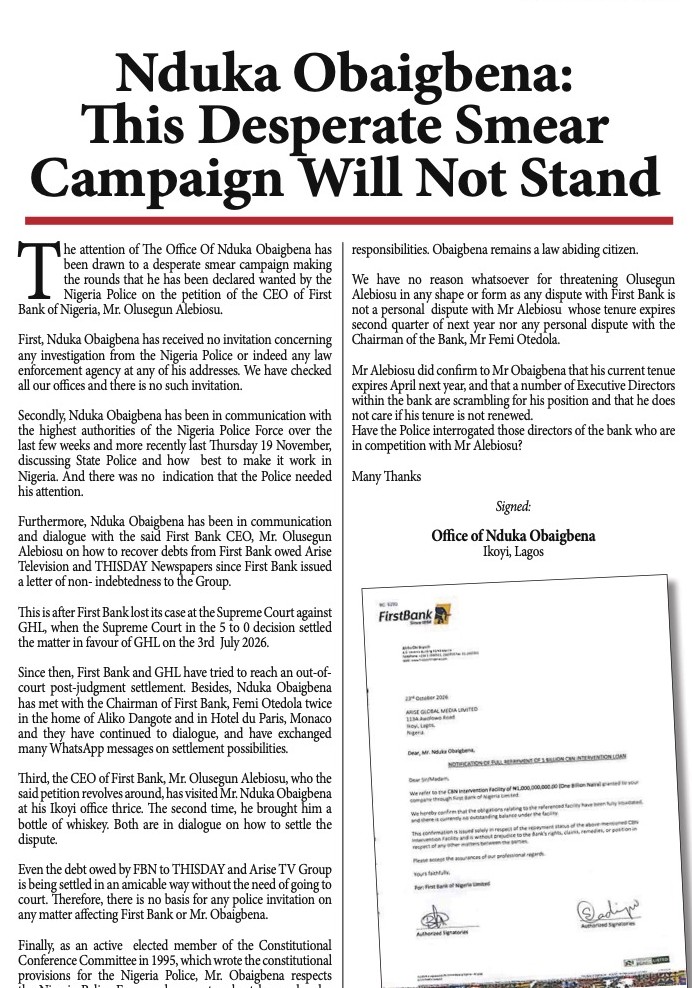
Obaigbena rejected the declaration outright. In a statement issued through his office in Ikoyi, he described it as a desperate smear campaign and said he had received no invitation from the police or any other law enforcement agency. He said he had spoken with senior police officials as recently as November 19 about proposals for state police, and nothing in those conversations suggested he was wanted for questioning.
He linked the controversy to financial disagreements involving FirstBank, General Hydrocarbons Limited, THISDAY and ARISE Television. His account, which the police have not corroborated publicly, states that FirstBank issued a letter of non-indebtedness to the media group, that the Supreme Court ruled 5-0 in favour of GHL on July 3, 2026, and that settlement talks were under way. He said he met FirstBank Chairman Femi Otedola twice in the presence of Aliko Dangote, at Dangote’s residence and at the Hotel du Paris in Monaco, and that Alebiosu visited his Ikoyi office three times.
What The Ammunition Parcel Investigation Actually Establishes
Confirmed facts are narrow. A parcel containing two rounds of 7.62mm ammunition reached the FirstBank managing director’s residence. It was reported on May 7, 2026. Detectives, ballistic experts and forensic investigators were assigned. Invitations went out in November. A wanted declaration was issued and then suspended.
Not established: who sent the parcel, why it was sent, and whether any of the nine had a role. The police have asserted a possible loan-recovery motive without publishing evidence for it, and Obaigbena has asserted a smear campaign without publishing the police correspondence he says does not exist.
The paperwork also shows a gap. PM News reported that the one person who honoured the November 12 invitation was Eze Obiefule Emmanuel of Energy Shield Petrochemical Limited, while the IGP’s list of those directed to report to the FID includes Eze David of the same company. Either the same firm has two executives in the file, or the names were not reconciled between commands. Neither possibility strengthens public confidence in a case this politically charged.
For Nigerian Businesses, The Precedent Outlasts The Headlines
Nigeria’s banks are carrying large volumes of disputed corporate debt, and lenders have repeatedly turned to police complaints in recovery fights. When a commercial disagreement can produce a wanted notice within a week of a missed appointment, the risk lands on every borrower, contractor and publisher who negotiates with a lender. The FID transfer does not remove that risk; it only relocates the decision.
The African angle is not abstract. Nestoil and Sahara Group operate across the energy value chain in West Africa, and their executives sit on files that counterparties and financiers abroad will read. A jurisdiction where a Zone 2 commander and the Inspector-General can issue opposite instructions on the same day complicates the due-diligence case for anyone lending into Nigerian projects.
There is also the press-freedom strand. Obaigbena owns two national platforms, and the declaration was issued against him while his companies were in a financial negotiation with the bank named as the complainant. The police have not suggested a link between the coverage and the complaint, and no evidence of one has been published. But the perception costs something in a country where the same police force is routinely accused of being drawn into civil disputes.
The measurable test now sits between November 26 and 30, when all nine are expected at the FID in Abuja. If the appearances happen and the investigation produces an evidenced account of who sent live ammunition to a bank chief executive, the system will have corrected itself. If the file instead settles quietly alongside a debt negotiation, the public will conclude that the IG suspends wanted declaration against Obaigbena and others only when the political cost becomes too high, which is a far weaker outcome for Nigerian institutions.
Frequently Asked Questions
Did the police withdraw the wanted declaration against Nduka Obaigbena?
The Inspector-General of Police, Olatunji Disu, directed that the wanted declaration be vitiated pending the final outcome of the investigation, and transferred the case from Zone 2 to the Force Intelligence Department in Abuja. The declaration was suspended, not finally resolved.
What led to the wanted declaration in the first place?
It followed an investigation into a parcel containing two rounds of 7.62mm live ammunition delivered to the Lagos residence of FirstBank Managing Director Olusegun Alebiosu and reported to the police on May 7, 2026. Ten people were invited on November 5 for questioning on November 12; police said only one appeared.
What happens next for the nine named individuals?
The police directed all parties to report to the Force Intelligence Department at the Nigeria Police Force Headquarters, Abuja, between November 26 and 30, 2026. The outcome of that investigation will determine whether any charge follows.
 Follow AFRILATEST on Google News
FIRST TIME REACTIONS:
Be the first to leave us a comment – IG suspends wanted declaration against Obaigbena, down the comment section.
JOIN US ON OUR SOCIAL MEDIA:

About Clare Dominic
Clare Dominic is the Editor at AfriLatest. With a background in journalism and a passion for storytelling, she oversees the editorial process to ensure content is accurate, engaging, and relevant. Clare works closely with contributors to maintain the highest standards of journalistic integrity across all news, sports, and lifestyle coverage.
View all articles by Clare Dominic
Nigeria News
INEC Chairman Raises Alarm Over Daily Threats to Officials
INEC chairman raises alarm over daily threat messages and political violence ahead of 2027, as a nationwide mock accreditation is set for November 28.
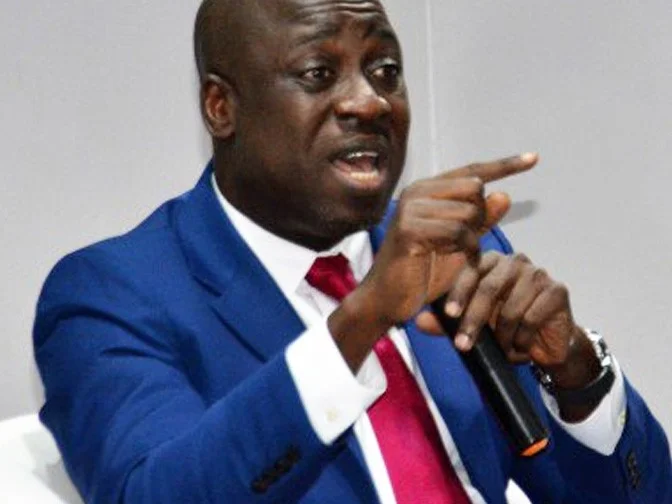
Nigeria’s chief electoral officer told his own field commanders this week that he is threatened almost every day, and that disclosure carries a direct cost for anyone who plans to vote in 2027. The officials being intimidated are the same ones who will configure accreditation devices, supervise temporary staff and certify results in a general election built on a register of more than 100 million voters.
Professor Joash Amupitan, chairman of the Independent National Electoral Commission, made the admission in Abuja on Wednesday while addressing Resident Electoral Commissioners from the 36 states and the Federal Capital Territory. The INEC chairman raises alarm at a point in the electoral calendar where, by his own account, the commission has no room to absorb error.
What Amupitan Said, And What Remains Unverified
“On a daily basis, I receive threat messages, and sometimes, you just feel like whether those distractions are necessary,” Amupitan said, according to a report by ARISE News. He described the role in blunt terms: “Working for the commission is like a thankless job. No matter what you do, you are under serious scrutiny and sometimes even abused.”
He extended the warning to the commissioners in the room, saying some of them had been receiving similar messages from groups “trying to intimidate and harass us.” His framing was institutional rather than personal: “If you think you are destroying INEC, you are only destroying democracy in Nigeria.”
The distinction between confirmed and unconfirmed matters here. Confirmed: the chairman said these words at a consultative meeting, and the commission has publicly acknowledged sustained pressure on its officials. Not confirmed in the public record: who is sending the messages, how many have been documented, and whether any formal complaint has been filed with the police or the Department of State Services. No arrest, case file or investigation was disclosed in the remarks.
Daily Threats That Explain Why The INEC Chairman Raises Alarm
The intimidation is not confined to staff inside the commission. On Monday, a campaign team belonging to former Deputy Senate President Ovie Omo-Agege was reportedly attacked during a visit to Uduere in Ughelli North Local Government Area of Delta State, with reports of six deaths. The account came from his sister, Mrs Regina Omo-Agege, a former INEC director of political party monitoring and liaison, in a statement issued in Abuja on Tuesday and reported by Apex News Exclusive.
She said firearms were reportedly present and used at the gathering, and appealed to President Bola Tinubu to guarantee her brother’s safety. She also called on the Inspector-General of Police and the DSS to investigate and prosecute sponsors. The death toll and the circumstances of the attack have not been independently confirmed by police in the statement, and should be treated as an allegation until security agencies publish findings.
INEC has been running a parallel track. At a security meeting with the Inspector-General of Police and party leaders at Force headquarters in Abuja, Amupitan warned that parties were breaching campaign rules and that political competition was being turned into a battlefield, Leadership reported. He cited his August 18, 2026 engagement with party leaders and the National Peace Committee, and pointed to Section 95(4) of the Electoral Act 2026 on rally venues and schedules. The commission is activating local government and ward-level structures of the Inter-Agency Consultative Committee on Election Security to map flashpoints.
A Register Of 100 Million Voters And A Zero Margin
The operational arithmetic explains the anxiety. Presidential and National Assembly elections are scheduled for January 16, 2027, with governorship and state House of Assembly contests on February 6. INEC plans a nationwide mock accreditation and result transmission exercise on Saturday, November 28, in two polling units per ward across the 36 states and the FCT, with technical reports due at headquarters by Monday, November 30.
The scale described by Amupitan: a verified register exceeding 100 million voters, 57,000 newly procured Bimodal Voter Accreditation System devices, and more than 1.41 million ad hoc personnel drawn from the National Youth Service Corps, university academics and the civil service. The commission has cut the BVAS deployment threshold from 1,250 to 850 registered voters per machine to reduce accreditation queues, and has built climate-controlled storage to protect device batteries.
“In an exercise of that scale, even minor administrative lapses in one state can trigger national headlines and cast doubt on otherwise solid work elsewhere. Margin for error simply does not exist,” he said. The commission’s recent experience covers off-cycle governorship elections in Anambra, Ekiti and Osun, the FCT Area Council elections and 16 legislative bye-elections over 13 months.
Money, Machines And Synthetic Media
Two further constraints sit outside the chairman’s control. Speaking through National Commissioner Sani Adam at the 13th Annual International Conference of the Association of Communication Scholars and Professionals of Nigeria, Amupitan said INEC has proposed a substantial budget with allocations for technology and replacement of devices lost or damaged in the last cycle, but that “full release of these funds is still being awaited,” according to The Sun.
He also conceded the reputational damage of 2023, when the INEC Result Viewing Portal buckled under load. “2023 also taught us, painfully and publicly, that the same portal whose purpose was to build trust can, when it falters under load or when uploads are delayed, become the very evidence cited to question that trust,” he said. The commission is auditing its systems for redundancy, penetration testing and disaster recovery, and has added automated arithmetic consistency and over-voting checks on Form EC8A before results upload.
He flagged AI-driven disinformation and coordinated false narratives as separate threats, warning that slow official communication creates the space they need. Officials found to have compromised neutrality, he said, will not be shielded under Sections 96, 97 and 148 of the Electoral Act 2026.
What To Watch
The November 28 simulation is the first real test: whether BVAS units hold charge, whether networks hold in riverine and insurgency-affected areas, and whether the November 30 reports document dead zones honestly rather than diplomatically. Watch, too, for the release of the technology budget, for any police statement on the Delta campaign attack, and for whether the threats against electoral officials are ever formally investigated rather than merely disclosed. The INEC chairman raises alarm in public; the test of 2027 is whether any institution answers it before the ballots are printed.
Frequently Asked Questions
What exactly did the INEC chairman say about threats?
Professor Joash Amupitan said he receives threat messages on a daily basis and that working for the commission is a thankless job. He spoke in Abuja on Wednesday at a strategic consultative meeting with Resident Electoral Commissioners from the 36 states and the FCT, and said some commissioners had received similar messages from groups trying to intimidate them.
When are the 2027 Nigerian general elections?
INEC has scheduled presidential and National Assembly elections for January 16, 2027, with governorship and state House of Assembly elections on February 6, 2027. A nationwide mock accreditation and result transmission exercise is planned for Saturday, November 28.
Has anyone been arrested over the threats or the Delta campaign attack?
No arrest, case file or investigation has been publicly disclosed in either matter. The threat messages described by Amupitan remain undisclosed in detail, and the reported deaths during the visit to Uduere in Ughelli North Local Government Area rest on a statement from the family, which called for a police and DSS investigation.
FIRST TIME REACTIONS:
Be the first to leave us a comment – INEC Chairman Raises Alarm Over Daily Threats to Officials, down the comment section.
JOIN US ON OUR SOCIAL MEDIA:
About Clare Dominic
Clare Dominic is the Editor at AfriLatest. With a background in journalism and a passion for storytelling, she oversees the editorial process to ensure content is accurate, engaging, and relevant. Clare works closely with contributors to maintain the highest standards of journalistic integrity across all news, sports, and lifestyle coverage.
View all articles by Clare DominicNigeria News
Nigeria Grants Aid: What NERSI And US Pacts Deliver
Nigeria grants aid through N50,000 NERSI cash transfers and unpublished US health pacts. What the record verifies, and what it still leaves out.


Two aid stories moved through Nigeria in the same season, and only one of them can be checked against a receipt.
On 30 October, the Minister of Humanitarian Affairs and Poverty Reduction, Dr Bernard Doro, announced that payments had begun under the National Emergency Relief and Stabilisation Intervention: N50,000 a month to vulnerable Nigerians, sent straight to a bank account or mobile wallet. In the same period, Nigeria appeared on a Council on Foreign Relations tracking list of more than a dozen African governments that have signed health memorandums with Washington since late 2025, agreements whose terms have not been fully published.
Nigeria grants aid to its own citizens through one channel and accepts it through another, and the evidence behind each is of very different quality. That gap, not the headline numbers, is the story.
What Nigeria Grants Aid Under NERSI Actually Changes
The mechanics of the cash programme are unusually specific for a Nigerian social intervention, and that specificity is what makes it verifiable. According to PUNCH, Doro said eligible beneficiaries receive N50,000 monthly, that the intervention is designed to cushion the effect of rising food prices and the high cost of essential goods, and that it will be reviewed regularly with beneficiaries notified before any adjustment.
The delivery model removes the queue. Beneficiaries do not apply, pay a fee or register through an agent. They receive an SMS from a licensed digital financial service provider asking for consent, and payment follows. The approved channels are ALAT by Wema (94523#), MoMo PSB (6710#), NairaGram (72600#), OPay (95520#) and Moniepoint (557327#). The ministry published a helpline, 0700-022-2222, and warned recipients not to share PINs or BVNs.
BBC Pidgin reported the same core claim: the government says the money goes directly to beneficiaries through mobile wallets, with no middle man.
What the announcement does not contain is just as important. It gave an amount and a channel, but no caseload, no total budget and no payment calendar. The Youth Economic Intervention and De-radicalisation Programme said in a Facebook post that beneficiaries were being notified, and advised those whose status read NOT SELECTED to wait for the next batch. The same post did not guarantee that everyone marked NOT SELECTED would be paid later. For a household, a confirmed N50,000 in a wallet is a real change. A NOT SELECTED status is not an outcome yet.
Why The US Health Pacts Signed By Nigeria Remain Unreadable
Nigeria’s second aid lane runs in the opposite direction, and here the announcement is the only solid fact. Al Jazeera reported that while Zimbabwe pulled out of negotiations and Zambia pushed back on clauses seeking access to critical minerals, several countries including Nigeria and Kenya went on to sign the health pacts. The terms remain unclear because the agreements have not been fully published.
The stakes are not abstract. African countries received $5.4bn in US assistance in 2024, much of it for health. After Washington suspended global health aid in January 2025 and dismantled USAID, Boston University’s Impactcounter tracker attributed 518,428 child and 263,915 adult deaths to the shock, along with close to 10 million new malaria cases. Zambia, which relies on PEPFAR for more than 80 percent of its HIV funding and free treatment for 1.3 million people, was told negotiations would end if no deal was inked.
Nigeria’s own terms are not public. That matters because the template is visible elsewhere. Senegal received $200m in overall US aid in 2024, about half for health, and is slated to get less than $100m over the next five years. Kenya’s $2.5bn deal was challenged in court, which suspended any part that might violate data privacy.
“Linking such aid to payoffs in the extraction of critical minerals smacks of exploitative practices,” Sarang Shidore, director of the Global South programme at the Quincy Institute for Responsible Statecraft, told Al Jazeera. “Reform in the foreign aid sector is badly needed, but this is not the way to do it.”
Where Nigeria grants aid without publishing terms, the accurate label is signed, not specified. Signing is an event. Coverage for a patient on antiretroviral therapy is an outcome.
British Council Grants And The Smaller, Checkable End
The third flow in this picture is small enough to audit line by line. The British Council awarded grants of up to £5,000 each to seven Nigerians under its 2026-27 Alumni UK Grant Programme, announced in Lagos on Thursday 19 November, for projects running five months. Four address climate and environment; three address inclusion and inequality.
May Tamara Stow will train 40 young women in Otuoke, Bayelsa State, to collect flood data from more than 200 households. Peter Abiye Banigo will train 30 informal solar technicians in Rivers State to handle discarded lithium batteries. Adelopo Abdulganiyu Omobolaji’s CircuRise targets 100 informal waste workers in Lagos. Bethel Ikenna Okeke will work with 100 girls and young women in the Durumi and Lugbe camps for internally displaced persons in Abuja. Charity K. Usifoh-Chenge expands a public health stewardship programme to Gombe and Nasarawa. David Chukwuma Izuogu’s Exam Equity for Girls reaches 150 girls in Lagos and Imo states. Opeolu Stephen Akinola will equip 50 graduates with disabilities with digital and employment skills.
Deputy Country Director Chilufya Besa was explicit about the limits. “A grant of up to £5,000 will not solve a national problem. It can, however, test an idea,” he said, adding that recipients must report on what they delivered, who they reached and what they learnt.
The Big Picture Is Scale And Proof
The three flows sit at wildly different sizes. A monthly N50,000 transfer to an unnamed number of households. A bilateral health arrangement of undisclosed value. A £5,000 project grant with a named lead and a five-month clock.
The reader’s test is simple. When Nigeria grants aid, ask three questions: who signed, how much, and what can be counted. NERSI answers two of the three. The British Council grants answer all three. The Washington health pacts answer one.
Frequently Asked Questions
How much is the Nigerian government paying under NERSI?
Eligible beneficiaries receive N50,000 monthly, according to Minister of Humanitarian Affairs and Poverty Reduction Dr Bernard Doro. The ministry said the intervention would be reviewed regularly in response to changes in the cost of living, with beneficiaries notified before any adjustment.
Do Nigerians need to apply or pay to receive the N50,000 relief?
No. Doro said beneficiaries are not required to apply, pay any fee or register through an agent. Payment follows an SMS consent request from one of the licensed providers: ALAT by Wema, MoMo PSB, NairaGram, OPay and Moniepoint.
What did Nigeria agree to in return for US health aid?
That is not publicly known. Nigeria is listed among countries that signed health pacts or memorandums with Washington, but the agreements have not been fully published, so the terms — including any data-sharing or minerals clauses — cannot be verified from the record.
FIRST TIME REACTIONS:
Be the first to leave us a comment – Nigeria Grants Aid: What NERSI And US Pacts Deliver, down the comment section.
JOIN US ON OUR SOCIAL MEDIA:

About Rosabella Eboh
Rosabella Eboh is an author at AfriLatest. With a passion for writing and a flair for creativity, she contributes original content and unique perspectives to the platform. Rosabella focuses on human-interest stories, cultural trends, and in-depth feature reporting.
View all articles by Rosabella EbohNigeria News
Nigeria’s NIP Keeps Africa’s Only Mature Payment Status
Nigeria’s NIP stays Africa’s only mature instant payment system in the 2026 SIIPS report, as ECOWAS picks Nigerian rails for a regional settlement plan.

Nigeria’s NIP remains the only instant payment system in Africa to hold the “mature” classification on AfricaNenda’s inclusivity spectrum. The status was confirmed, not newly won, in the 2026 State of Inclusive Instant Payment Systems report released on Thursday by the AfricaNenda Foundation with the World Bank Group and the United Nations Economic Commission for Africa. Two different claims are bundled into that headline, and only one of them moved this year: that the payment rails are built to a high standard, and that the market around them is producing measurable results.
The report counted 39 instant payment systems live across 43 African countries. Eleven were classified as progressed, 19 as basic and eight went unranked. Nigeria’s NIP was the only entry at the top, as Nairametrics reported.
Why Nigeria’s NIP Leads A Field Of 39 Systems
“Mature” is not a marketing word in this framework. AfricaNenda requires extensive payment use cases, affordable services, working consumer protection and a functioning route for disputing failed transactions. Systems are also judged on whether they carry government payments, business transactions and cross-border transfers, not only person-to-person transfers.
Nigeria’s NIP, operated by the Nigeria Inter-Bank Settlement System (NIBSS), climbed from basic in 2021 to progressed and then to mature, first announced at the 2025 report launch in Ezulwini, Eswatini. The 2026 edition records that it held the grade while other countries continued building.
What earns the grade, per THISDAY: heavy participation by banks, fintechs and non-bank operators; always-on digital access; simplified onboarding for low-income users; and a technology backbone that sustains high throughput with real-time settlement. Consumer protection and dispute resolution carried weight too.
The coverage figure is the sobering one. Twenty-three African countries now have systems rated progressed or mature, and those systems reach 56% of the continent’s adult population. The other 44% sit outside them.
Read the tables, not only the summary. The 2026 report states that “the remaining systems maintained their 2025 classifications, including ten already at progressed and one (NIP in Nigeria) at mature”, while elsewhere listing 11 progressed systems. That gap suggests one system moved up without the summary saying so.
The ECOWAS Hosting Deal Is The Change That Actually Happened
The most concrete new development came from Monrovia’s central bank, not from Abuja. Henry Saamoi, Governor of the Central Bank of Liberia, told reporters on the sidelines of the report launch in Mauritius that West African authorities are finalising a regional payment settlement system for ECOWAS, with Nigeria hosting the instant payment leg because of the country’s NIP experience.
Saamoi said a consultant engaged by ECOWAS recommended a three-country split: Nigeria for the instant payment system, Ghana for a backup, and the Central Bank of West African States in Senegal for the real-time gross settlement system. He said the arrangement was designed to answer governors’ fears that a single country would dominate the infrastructure. His account is reported here.
Settlement currency remains unresolved. Saamoi said no base currency has been chosen, that member states are onboarding to the Pan-African Payment and Settlement System, which settles in local currencies, and that a major decision on the proposed ECO single currency would be taken on Friday in Abidjan. The 2027 target for the ECO, he said, is unchanged.
The distance between the ranking and the ECOWAS plan is worth stating plainly. One is a published assessment of a live system. The other is a consultant’s recommendation endorsed by central banks, with no launch date attached to it.
NIBSS Is Already Building The Replacement For Its Own Flagship
The system being certified is also the system scheduled for retirement. NIBSS introduced the National Payment Stack in June 2025 as an ISO 20022-compliant national infrastructure with richer payment data, instant settlement and multi-rail capability. It processed 153,000 transactions in pilot as of June 2026.

Set that against the numbers Nigeria’s NIP already handles. Electronic payments through the platform reached N1.07 quadrillion in 2024, up 79.6% from N600 trillion in 2023, with volume up 15.5% to 11.2 billion transactions. The pilot figure is a rounding error beside the rail it will eventually replace.
That gap is the honest measure of where the migration stands. It carries a risk as well: when the new stack takes over, the maturity grade belongs to the older rail until a fresh assessment says otherwise.
Inclusion has a hardware problem too. In January 2026, NIBSS disclosed plans to explore offline payment options for Nigerians using basic mobile phones or without reliable internet. A system can be mature and still be out of reach for the people it was designed to include.
The Big Picture
Across the continent, 19 of 39 instant payment systems remain basic, several without merchant payments or complaint channels, according to the report. Nigeria’s NIP is not proof that Africa’s payment infrastructure has arrived. It is proof that a system can be assessed at the top of a scale while millions of people in the country around it remain outside that system. The grade is a floor, not a finish line, and for Nigeria’s NIP the next test is whether the platform built to replace it can hold the same standard.
Frequently Asked Questions
What does ‘mature’ mean for Nigeria’s NIP in the 2026 SIIPS report?
It is the highest tier on AfricaNenda’s Inclusivity Spectrum. Systems at that level must offer extensive payment use cases, affordable services, effective consumer protection and dispute-resolution mechanisms, and must support government payments, business transactions and cross-border transfers.
Did any other African instant payment system reach mature status in 2026?
No. Of the 39 instant payment systems tracked across 43 countries, 11 were classified progressed, 19 basic, eight unranked, and Nigeria’s NIP was the only system in the mature category.
What role does Nigeria’s NIP play in the planned ECOWAS regional payment system?
Central Bank of Liberia Governor Henry Saamoi said a consultant recommended a three-country arrangement in which Nigeria hosts the instant payment system because of its NIP experience, Ghana hosts a backup, and the Central Bank of West African States in Senegal hosts the real-time gross settlement system. The settlement base currency has not been decided.
FIRST TIME REACTIONS:
Be the first to leave us a comment – Nigeria’s NIP Keeps Africa’s Only Mature Payment Status, down the comment section.
JOIN US ON OUR SOCIAL MEDIA:
About Rosabella Eboh
Rosabella Eboh is an author at AfriLatest. With a passion for writing and a flair for creativity, she contributes original content and unique perspectives to the platform. Rosabella focuses on human-interest stories, cultural trends, and in-depth feature reporting.
View all articles by Rosabella Eboh-

 Car Reviews3 weeks ago
1955 Chevy Bel Air Restomod: What SEMA Really Proves
-
Health and Fitness4 weeks ago
Medicare 2027 Changes: Costs, Drug Prices and What to Do
-
Celebrities4 weeks ago
Celebrity Traitors Final Predictions: Ex-Players On Tactics
-
Celebrities3 weeks ago
Hailey Bieber PMDD Diagnosis Followed Son Jack’s Birth
-
Health and Fitness4 weeks ago
Dylan Dreyer Hair Part Change: What’s Real And What’s Hype
-
Nigeria News3 weeks ago
NAJA Names Weststar Chairman Auto Legend For 2026