
AI & Technology
Mel Ismail Shark Encounter: How He Survived
Mel Ismail shark encounter: the surfer punched a shark in the eye, lost his leg, and survived. Here’s exactly how he did it.


You want to know what actually happened when a shark took a surfer’s leg off the coast of Western Australia. Not the tabloid version. The sequence of events, the decisions, and the rescue chain that kept a 56-year-old firefighter alive. The Mel Ismail shark encounter gives you a real survival playbook, and almost none of it is what you’d guess.
Here’s what the record shows, step by step.
Prerequisites: What He Had Going In
Ismail is a professional firefighter and part-time teacher. He was surfing alone at Glenfield Beach near Geraldton on Sept. 14, sitting out the back of the surf break. He had years of ocean experience and knew the risk. He’d just watched a pod of about 20 dolphins.
That’s the baseline. Experienced waterman, solo session, no boat, no partner, no immediate help.
Step 1: Identify The Threat Before You Fight It
The first hit came from behind. Ismail told the Australian Broadcasting Corporation he thought he’d been struck by a dolphin.
Then something grabbed him and dragged him under. That’s when the assessment flipped. “And I knew it was a shark,” he said.
The lesson: don’t lock in on your first read. Dolphins were the obvious explanation. The shark was the correct one.
Step 2: Attack The Eyes When You’re Being Held
Ismail found himself face-to-face with the animal. He described a big black eye. He jammed his fingers into it and pushed while he was being dragged.
He later told ABC it looked like the shark winked at him. There’s a mechanical explanation. Many sharks, including white sharks and makos, don’t have eyelids. When they attack prey, they roll their eyeballs backward into their sockets to protect them, exposing a tough white cartilage layer. What looks like a wink is a protective reflex.
Either way, the eye was the target, and it was the only thing within reach.
Step 3: Accept The Injury And Stop Bleeding
Ismail realized his right leg had been severed below the knee. He didn’t stay in the impact zone. He caught a wave that carried him roughly 20 meters, about 66 feet, toward shore.
He was out of breath and losing strength. This is the part most people get wrong in survival accounts. He didn’t swim. He used the ocean’s energy to move himself.
Step 4: Take The Help That Shows Up
Surfer Shannan Dunn was coming down the dunes. Ismail said his spirits lifted at the sight of him. Dunn paddled out, got Ismail onto his board, and started the chaotic trip back.
According to ABC News, the two fell off the board at stages and climbed back on. Dunn’s words, as Ismail recalled them: “I got you mate, we’ll get you in.”
Dunn’s first question was where the shark was. Ismail’s answer: “I don’t know. I’ve got a bit going on here.”
Step 5: Improvise A Tourniquet From Surf Gear
On the beach, an onlooker made a tourniquet from a leg rope. A woman named Chrissy called for help. Teenage cousins Cruz and Clay McDonald and their friend Jasper Hill, who had been surfing during the attack without realizing it, rushed in and fashioned a second tourniquet from another leg rope.
They loaded Ismail into Dunn’s four-wheel drive. Dunn drove along the beach to meet an ambulance.
Step 6: Keep The Patient Talking
Ismail said people in the back of the truck were laughing and keeping him positive. He gave fist bumps. “I started to feel like I was going to make it,” he said.
That’s not soft detail. Keeping a severely bleeding patient conscious and oriented is part of the chain.
Step 7: Hand Off To Trained Responders
Paramedics, volunteers, nurses and doctors took over. Dr. Mary Pinder, head of the ICU, said Ismail remained in stable condition but faced a long recovery. His partner, Kylie Fleay, was working her first solo shift on the hospital switchboard when word came in. She raced to meet him.
“Every time I hear the story,” she said, “it just amazes me more what he went through and survived.”
The Result: Adapt, Improvise, Overcome
Three weeks after the attack, Ismail was home in Geraldton adjusting to life without his lower right leg. He’d already returned to the gym. He plans to go back to work and back in the water, likely starting on a bodyboard or a soft-top surfboard.
He hasn’t held his broken surfboard since the attack. He said he’ll do it soon, with friends around.
He also doesn’t resent the shark. Fisheries authorities never identified the species. “A shark took my leg. It wasn’t an elephant, and it wasn’t a donkey,” he said. He’s staying out of the shark-mitigation debate that reignited after 63-year-old swimmer Greg O’Neill was fatally mauled at Sorrento Beach in Perth four days later, about 400 kilometers south.
What He Wants You To Take From It
Ismail’s stated goal is to redirect attention to the people who saved him. He called first responders, paramedics, volunteers, nurses and doctors “heroes” and said the public doesn’t hold them up highly enough.
His advice to anyone scared off by the attack: don’t let fear stop you. “There are so many car crashes, and we don’t put enough fear into people about that,” he said. “Go back and do what you need to do. If you love surfing, surf.”
Australia has averaged two to three fatal shark attacks a year since 2000, per the Australian Shark Incident Database. Five people died in attacks in Australia this year, including three spearfishing divers over May and June and a 12-year-old boy in Sydney Harbor in January.
Your Next Step
The Mel Ismail shark encounter is a case study in sequence: assess, fight the only target available, use the water to move, accept help, improvise gear, keep the patient engaged, hand off to professionals. If you surf, paddle, or swim in open water, learn to make a tourniquet from what you’re already carrying. A leg rope did it. Know who’s on the beach. And read the full accounts at ABC Midwest & Wheatbelt and People before you form an opinion on shark mitigation.
Frequently Asked Questions (Mel Ismail shark encounter)
When and where did the Mel Ismail shark encounter happen?
Ismail was attacked on Sept. 14 while surfing at Glenfield Beach near Geraldton on Australia’s west coast. He lost his right leg below the knee.
Did the shark actually wink at Mel Ismail?
Ismail said it looked like a wink. Many sharks, including white sharks and makos, don’t have eyelids and roll their eyeballs backward into their sockets during an attack, exposing a tough layer of white cartilage.
Who rescued Mel Ismail after the shark attack?
Surfer Shannan Dunn paddled out and got Ismail onto his board. On shore, Chrissy called for help, teenagers Cruz and Clay McDonald and Jasper Hill made a second tourniquet from a leg rope, and Dunn drove Ismail along the beach to an ambulance.
Related Articles
- Herbal Remedies: Aishat Alagbo’s Safe Use Guide
- 29MB AI Model Runs on a $10 Chip: Here’s How
- Health Workers to Sue 20 Varsities Over Unpaid Allowance
- Taylor Swift Joins Beatles as Only Acts With 100 Weeks at No. 1
- Saints vs Vikings: Why the Data Says Take New Orleans
 Follow AFRILATEST on Google News
FIRST TIME REACTIONS:
Be the first to leave us a comment – Mel Ismail Shark Encounter: How He Survived, down the comment section.
JOIN US ON OUR SOCIAL MEDIA:

AI & Technology
OpenAI AI Agents Finish 46% of Research Tasks: What It Means
OpenAI AI agents complete 46% of two-to-four-hour research tasks. What the report proves, what it hides, and what it really costs Nigerian teams.


OpenAI AI agents are software processes that carry out multi-step research work — launching training runs, reading results, writing code — with nobody stepping in, and the company now says they finish 46% of tasks that would take a human two to four hours.
That number comes from an internal report published on November 18, and it is the most useful thing OpenAI has released about agents this year. Not because 46% is impressive, but because it is specific. It can be checked, argued with, and priced. A launch video cannot.
The catch sits one line below the headline. In March, the same measure read 23%. The improvement is real on paper. But OpenAI’s own write-up concedes that the task mix changed over those seven months, which means stronger models and better decisions about what to delegate could both explain the jump. A rising number measured against a moving set of tasks is a trend, not a proof.

What the OpenAI AI Agents Report Actually Measures
The report splits work by human hours and by task type, which is where it earns its keep. On assignments needing four to eight human hours, success climbed from 13% to 35%. On assignments needing two to four hours, it went from 23% to 46%.
Then the jagged edge appears. Between August and October, agents completed 69% of communication tasks and 58% of analysis tasks against 43% of build tasks. At task level, monitoring a training run scored 79%, answering technical questions 72%, launching a training run 35%, building evaluation or reinforcement-learning environments 29%, and writing code for inference and serving stack 25%.
That last figure is the one to read twice. The cheap, checkable work is already automated. The expensive, judgment-heavy work is not. Anyone who has tried to hand an agent an open-ended engineering problem in Lagos or Nairobi will recognise the pattern: fast first draft, expensive cleanup.
Where the Agents Fail, and Why That Matters More
OpenAI interviewed 10 researchers and surveyed 101. The complaints were consistent and specific: poor research taste, weak sense of code quality, an inability to separate good data from bad. One pretraining researcher said they still had better research taste than the models but had no confidence that would last. Others described piles of what they called AI slop.
The company also recorded what happens when agent output goes unchecked. On October 6 it released mathematical results from an internal model; the next day, three manuscripts were withdrawn after a sign error undermined an argument, and fourteen others were revised.
This is the part vendors usually leave out. According to TechRadar’s account of the report, apparently completed assignments frequently contain mistakes that require substantial human correction. Supervised agents are fast in the direction you chose. Unsupervised agents are equally fast in a direction nobody chose.
The Cost Line Nobody in Lagos Should Copy
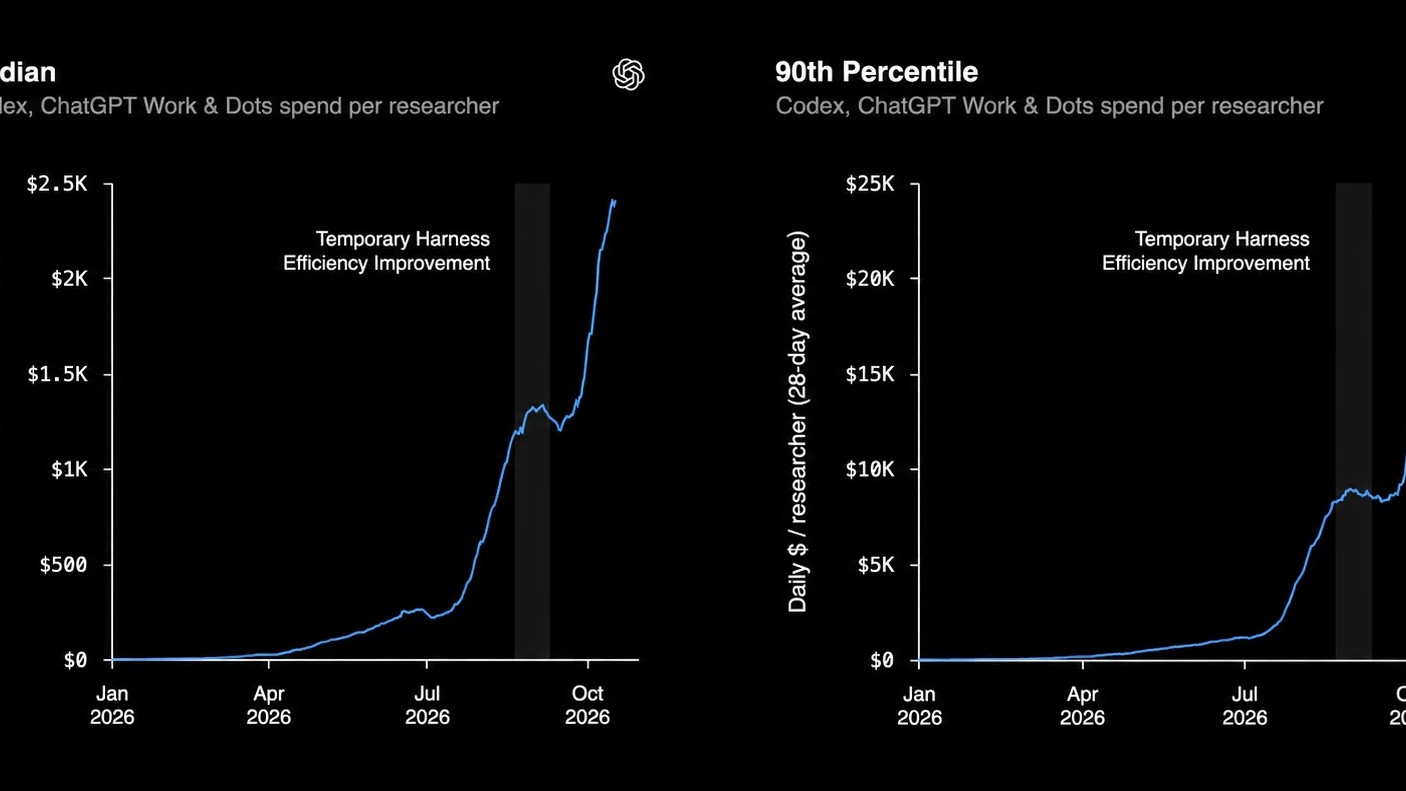
The spending numbers are the ones that will get screenshotted. Median daily agent spend per researcher reached $2,400 in October, up 62% from $1,500 in September. At the 90th percentile it hit $23,000, more than double September’s $11,000. Runtime averaged 5.7 agent workdays per researcher per day, an elevenfold increase.
For a Nigerian team, that is not a price list. Those figures are OpenAI’s own valuation of internal usage at API list prices — what the tokens would have cost at published rates — not a subscription anyone sells. No local pricing tier, naira billing or usage cap appears in the report. Reading the $2,400 as a monthly plan is a category error.
The survey result is stranger. Asked what they would trade for three months of frontier coding agents, the median of 101 researchers offered 40% of their team’s headcount, or 30% of team compute. Staff were also asked to name what agents do not do well, and the answers clustered around problem selection — deciding which question is worth asking.
Privacy and governance get thinner treatment. The published report does not set out data retention, residency or access terms for agent-generated work. That gap matters most in markets where client data crosses borders by default.
How to Use This Without Believing the Headline
Treat the 46% as a ceiling measured on a favourable task mix, then test it on your own work. Give an agent a bounded, verifiable job — monitoring a pipeline, summarising a test run, drafting a changelog — and score the output before it touches production. The categories with documented high success are precisely the ones where a reviewer can check the result cheaply.
Alternatives behave differently, and their numbers are not interchangeable. Anthropic’s own assessment put Claude at the helm of 26% of its AI research and development work in August, up from under 1% in February, using a different definition of what leading a task means. An external METR assessment published November 5 estimated that AI assistance had lifted benchmark improvement to 1.9 times the historical rate, with a confidence interval of 1.5 to 2.8, while conceding the study was not a controlled experiment and that much of the evidence had been redacted.
Even OpenAI’s headline progress metric is not a clean comparison. Its internal capabilities index rose 16.4 points a year since August 2025; Epoch AI measured 14 points a year since late 2024 on a different benchmark mix. Different rulers, similar direction. That is worth noting before anyone claims one lab is definitively ahead.
The honest reading is that OpenAI AI agents have become a real productivity tool for narrow, checkable work and remain a supervised intern for everything else. The report itself concludes that humans remain a core part of the AI research loop, and chief economist Aaron Chatterji wrote that the company needs to share data regularly so outsiders can draw their own conclusions. That invitation is the correct test: not the press release, but whether the published numbers hold up when other people rerun them.
Who should use it: teams with a defined pipeline, a reviewer with authority to reject output, and a dollar budget they can watch daily. Who should not: anyone assuming the 46% transfers to open-ended research, client-facing delivery or regulated data, or anyone who mistakes a self-reported internal metric for a product guarantee. Judge OpenAI AI agents by the corrections their output still needs — that number, not the headline, tells you what you are actually buying.
Frequently Asked Questions
Do OpenAI AI agents really complete nearly half of research tasks on their own?
On OpenAI’s own internal measure, agents completed 46% of delegated tasks estimated at two to four hours of human work in October, up from 23% in March. The report itself notes the task mix changed over that period, so better models and better delegation choices could both explain the gain. The figure covers OpenAI’s research work, not general business tasks.
Does $2,400 a day mean I need that budget to use coding agents?
No. That figure is OpenAI’s valuation of its own researchers’ agent usage at API list prices — what the tokens would have cost at published rates. It reflects very heavy internal use, with the top 10% of users at $23,000 a day. Ordinary usage is billed per token at whatever rate your provider charges, and the report describes no local pricing tier.
What are OpenAI AI agents still bad at?
The report is specific. Writing inference and serving code hit 25% autonomous success, building evaluation and reinforcement-learning environments 29%, and launching training runs 35%. Researchers also flagged weak research taste, poor code quality judgement and difficulty telling good data from bad, which is why close supervision remains necessary.
FIRST TIME REACTIONS:
Be the first to leave us a comment – OpenAI AI Agents Finish 46% of Research Tasks: What It Means, down the comment section.
JOIN US ON OUR SOCIAL MEDIA:

About Xavier Catherine
Xavier Catherine is the Technology Lead at AfriLatest. With a background in computer science and a focus on innovation, he oversees the platform's technology infrastructure. Xavier also contributes reporting on AI, gadgets, and cybersecurity, ensuring AfriLatest remains secure, reliable, and user-friendly.
View all articles by Xavier CatherineAI & Technology
AI Agents Misread Data: What SAP’s Platform Really Fixes
AI agents misread data across company boundaries when ‘Priority’ means two things. A practical review of SAP Business AI Platform’s knowledge graph and limits.

AI agents misread data even when every field is correct. SAP Business AI Platform is SAP’s attempt to fix that: a governed environment that gives agents a knowledge graph of customers, suppliers, products and processes, an ontology that pins down what each term means, and an audit trail on every action taken.
The failure it targets is documented. Writing for TechRadar Pro, Exalate co-founder and CEO Francis Martens describes an agent syncing Jira and ServiceNow that assumes “Priority” means the same thing in both systems. It draws inferences from that assumption, syncs them, and a Priority 1 incident misses its SLA. The affected teams never find out, because the agent reported the ticket as handled. The output was plausible.
Why AI Agents Misread Data That Is Technically Correct

Martens’ diagnosis is the sharpest contribution in the current debate. When agents produce a wrong answer, the reflex is to grant more permissions: read more fields, more records, more systems. That treats context as volume. It is not. Context is interpretation: what a field in one system means in another, how workflow states map to each other, how two tools define the same word. That knowledge lives in the relationship between connected systems, and it differs for every deployment.
SAP’s research chief makes a compatible argument from the other end of the stack. Yaad Oren, Global Head of Research and Innovation at SAP Labs U.S., argues that retrieving data with a customer’s name and total amount is not enough. An agent needs the connections around that customer: how many sales orders, their satisfaction rate, how many delayed shipments, which manufacturing plant the orders came from. Without them, a valid invoice gets blocked, because the invoice itself does not reveal the vendor’s parent company or the credit arrangements that apply.
What SAP Business AI Platform Actually Does
The clearest worked example in SAP’s material is the word “invoice.” One department means a customer payment, another a travel reimbursement, a third a supplier bill. A knowledge graph can link every invoice in a company and still leave an agent with contradictory signals. The ontology is what forces one meaning across systems and carries it into every agent that queries the graph.
The second example is operational. SAP calls it a “parked document”: catering invoices waiting to be split across budgets after a company event, stalled because the controller is on parental leave. An agent without process context reads that as a serious delay. An agent with context reads it as an exception and leaves it alone. Oren’s point is that the same data supports opposite decisions depending on whether the agent knows who is missing and why.

Underneath, SAP argues general-purpose language models are the wrong tool for tables. Its answer is RPT-1.6 (Relational Pre-trained Transformer) and TabPFN-3.5 Plus from Prior Labs, SAP’s frontier AI lab, built for missing values, mixed data types and high-cardinality fields. A tabular orchestration capability in AI Core handles context selection and data access at runtime so predictions can enter production workflows rather than stay in a notebook.
The platform is organised in four layers: models that read relational data, the platform layer holding graphs, semantics and governance, agents that act across finance and supply chain, and the user interface. SAP’s claim is that the platform layer is the one that matters, because a finance agent and a supply chain agent can then reason from the same representation of a customer instead of rebuilding it separately. Governance sits there too: agents run under provisioned identities with scoped permissions, and the audit trail records who acted, under what authorisation, and what was done.
That last detail carries more weight than the demos. A bad answer can be ignored. A wrongly blocked payment or rejected order hits a supplier the same day.
The Evidence Gap Buyers Should Notice
The long VentureBeat article making SAP’s case is labelled “Presented by SAP.” It is a sponsored post, not independent reporting. The technical reasoning stands on its own logic, and Oren’s examples are concrete. But no benchmark, error rate, deployment count or named customer appears in the material, and no third party has tested the claims there.
Pricing is also missing. SAP did not publish BAIP costs, implementation timelines or regional availability in the material reviewed. For a Lagos or Nairobi mid-market firm, those are the first questions, not the last. An agent platform priced for a European enterprise budget is not automatically viable for a distributor running a support desk and an ERP that disagree about what “open” means. Ask for local-currency quotes, data residency terms and a reference customer before signing anything. Features beyond the knowledge graph, ontology and tabular orchestration were not fully confirmed in the source material.
Wipro’s Alternative: Less Frontier Model, More Orchestration

Wipro’s Hari Shetty, Chief Strategist and Technology Officer, describes a different architecture in a separate TechRadar Pro interview: an orchestration layer over a mix of frontier and smaller enterprise-specific models. His argument is that most enterprise tasks do not need a frontier model. A smaller model grounded in the right data is cheaper, easier to govern and better suited to the domain. Wipro has set up an AI-Native Business and Platforms Unit around that bet.
Shetty also supplies the measurement rule that cuts through vendor noise. Agent counts reveal little, because there is no consistent way to define an agent: one organisation calls ten functions ten agents, another bundles the same capability into one. The better measure is work completed against a business outcome, such as fewer missed SLAs, faster reconciliation or better fraud detection. He cites an industry report putting 40% of large organisations at active agentic-AI scaling, and another finding that only 13% of employees feel rewarded for reinventing their work with AI when results are not immediate. Both numbers point at the same constraint. It is organisational, not model capability.
Who Should Use It, And Who Should Wait
SAP Business AI Platform suits organisations already running SAP across finance and supply chain, with processes that span systems and staff who can own the ontology and keep it current. The value is real when the alternative is an agent quietly blocking invoices.
It is a poor fit for a small firm with two or three SaaS tools and no data steward. A written mapping rule and a weekly human reconciliation will be cheaper. It is also a poor fit for any buyer who needs published pricing before a board decision, because there isn’t any.
The test is not how many agents a vendor ships. It is whether AI agents misread data less often after deployment, and whether anyone can prove it with an audit trail. On that measure, SAP has described the right problem and a specific mechanism. The proof is still owed.
Frequently Asked Questions (AI agents misread data)
Why do AI agents misread data that is already accurate?
Because accuracy is not the same as meaning. As Exalate CEO Francis Martens explains, an agent syncing Jira and ServiceNow can assume ‘Priority’ means the same thing in both systems and act on that assumption. The records are correct; the interpretation is wrong, and a Priority 1 incident then misses its SLA without anyone noticing.
Does giving an AI agent more permissions fix cross-system errors?
No. More permissions increase data volume, not context. What the agent lacks is the mapping between systems: how a field in one tool corresponds to its counterpart in another, and how workflow states line up. That mapping is specific to each company’s setup and has to be defined, usually through a knowledge graph and a shared ontology.
How much does SAP Business AI Platform cost?
SAP has not published pricing for BAIP, nor implementation timelines or regional availability, in the material reviewed. Buyers should request local-currency quotes, data residency terms and a reference customer before committing. Independent testing of the platform’s claims was also not available at the time of writing.
FIRST TIME REACTIONS: (AI agents misread data)
Be the first to leave us a comment – AI Agents Misread Data: What SAP’s Platform Really Fixes, down the comment section.
JOIN US ON OUR SOCIAL MEDIA:
About Xavier Catherine
Xavier Catherine is the Technology Lead at AfriLatest. With a background in computer science and a focus on innovation, he oversees the platform's technology infrastructure. Xavier also contributes reporting on AI, gadgets, and cybersecurity, ensuring AfriLatest remains secure, reliable, and user-friendly.
View all articles by Xavier CatherineAI & Technology
Scout Motors AI Training: Earpieces, Hype and Reality
Scout Motors AI training puts an AI assistant in factory workers’ earpieces. What it actually does, what it costs, and where the evidence stops.

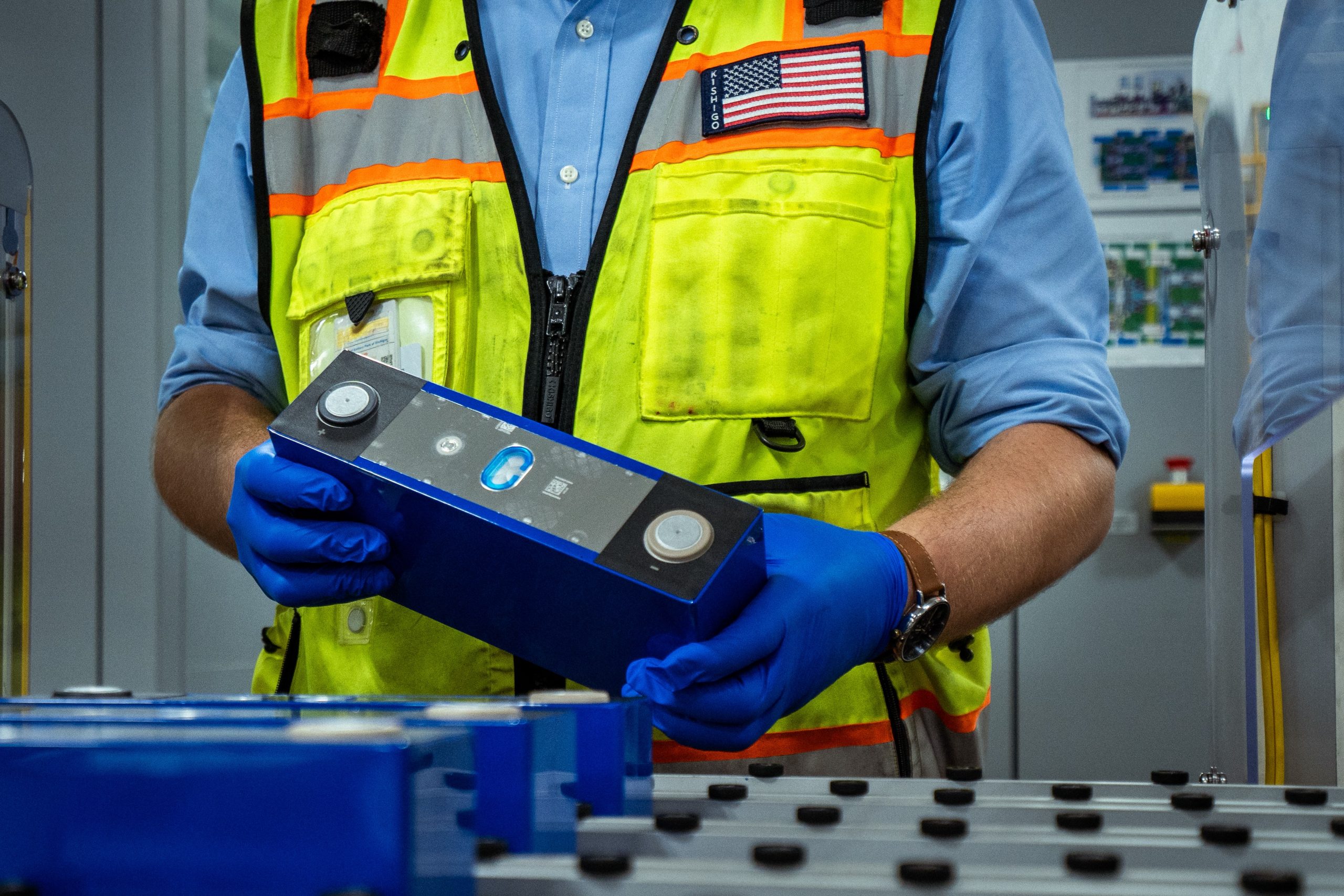
Scout Motors AI training, as the company describes it, means a new factory hire learns a parts-picking sequence in minutes with an AI voice in their ear instead of a binder and a written test. That is the pitch. What has actually been shown is narrower, and nobody outside Blythewood, South Carolina has tested it.
The framing is deliberate. “AI training” normally means teaching a model. Scout says it is doing the reverse: using AI to hire, onboard and teach the people who will build its trucks. CEO Scott Keogh made the case at a reporters’ roundtable at the company’s still-under-construction plant, as CNET reported.
That roundtable is the entire public record. No product name, no price, no pilot data, no third-party evaluation.

What Scout Motors AI Training Actually Does On The Line
Keogh breaks manufacturing into a set of fundamental tasks and builds the AI around teaching each one. His example is parts picking: a worker walks to 12 boxes, pulls 12 parts, confirms they are in the right sequence and checks them for defects. The earpiece talks the worker through that sequence in real time, adapting the instructions as they go.
The loop is repetition. Keogh says a worker runs the cycle about 15 times, gets faster and better each pass, then moves down the task line to the next skill. “We can train that within minutes,” he said.
Scout Motors AI training has a second layer before any of that starts. Todd Johnson, vice president of manufacturing, says new hires’ backgrounds are fed into a system that suggests where each person fits: a former forklift driver steered toward logistics, someone without final assembly experience toward the body shop, a painter placed as a painter. Training data then feeds back in to tune hiring and placement.
Where The Evidence Runs Out
Three things are missing, and all three decide whether this is a real advance or a good story.
Cost is undisclosed. Scout has not said what the earpieces cost per worker, whether the software is licensed or built in-house, or what the running cost is once the plant approaches its designed rate of around 40 vehicles an hour. CNET’s factory tour put the Blythewood investment above $2 billion plus a $300 million supplier park. There is no line item for training technology.
Independent testing is absent. Every performance claim comes from the company making it. No published time-to-competence figure, no defect rate, no comparison against a control group trained the old way.
And the reporter on the ground was openly unconvinced. CNET’s Antuan Goodwin wrote that parts picking “doesn’t sound like the sort of task you’d need an AI system to help with,” and that the placement logic “sounded a lot like common sense.” Scout’s executives partly agreed, arguing the benefits grow as tasks get more complex. That is the honest state of it: a plausible internal tool with an unproven edge.
A Company That Publishes Demand Data But Not Training Data
The contrast is worth holding onto. Scout has been precise about reservations: more than 160,000 holders, roughly 87% of whom picked the Harvester range-extended configuration over the pure electric version, which is why the company flipped its launch order and will ship the extended-range trucks first. Those are checkable numbers with commercial consequences.
On training, the numbers are adjectives. Fast, efficient, more productive. For a system the company says will shape how quickly the factory ramps, that asymmetry is the story.
Privacy And Placement Are The Undemoed Risk
Feeding a new hire’s work history into a model that recommends where they should work is a hiring decision made by software. Scout has not described any audit, appeal route or bias testing for that step, and has not said how long background data is kept or whether a worker can see what the system concluded about them.
None of that makes the system wrong. It makes it unaudited, and placement models have a way of reproducing whatever patterns sit in the data they learn from.
The Alternatives Are Unglamorous And Available Now
Instruction binders and classroom sessions are what Scout says it replaced. Shadowing a senior worker on the line costs a trainer’s hours but needs no hardware. Recorded video walkthroughs of a task can be shot on a phone. None of these claim to be adaptive; all of them can be measured.
The fair comparison for any plant is not AI versus nothing. It is AI versus the method already running, judged on hours-to-competence and defect rates.
What This Would Take In Nigeria
Scout’s plant sits in a region without a large pool of experienced automotive workers, which is the stated reason placement software matters there. The same logic applies to industrial clusters around Lagos, Ogun and Aba, where employers routinely hire people with adjacent rather than direct experience. Scout pledged more than 4,000 local jobs when it broke ground, and that is the scale at which a training method stops being a novelty.
But an earpiece is a harder tool than a tablet. It needs continuous audio, speech recognition that handles local accents, and a floor quiet enough to hear over. Scout’s body shop runs more than 750 robots across 5,000 weld points. The company has not said which languages or accents the assistant supports, or how it performs under that noise. Until it does, the Nigerian relevance is a hypothesis, not a plan.
Who Should Use It
Scout should, as an internal pilot with published metrics: time-to-competence against a control group, defect rates, and a written rule on what the placement model is allowed to see.
Everyone else should wait. No version of this is on sale. No independent test exists. By Scout’s own timeline the plant is 80% to 95% built, validation runs through 2027, and the first customer deliveries of the Traveler Harvester begin in early 2028. A manufacturer weighing AI earpieces today is being asked to buy a demo.
The useful test for Scout Motors AI training is not whether the earpiece sounds impressive in a roundtable. It is whether a worker trained on it in 2027 is measurably faster, and no less safe, than one trained with a binder a year earlier. Publish that, and the claim earns its weight.
Frequently Asked Questions
What is Scout Motors’ AI earpiece training system?
It is an internal tool Scout Motors says it uses to onboard factory workers. An AI assistant in an earpiece talks a trainee through a task in real time, such as pulling 12 parts from 12 boxes in the correct sequence. Scout says workers repeat a cycle about 15 times and then move to the next skill.
Can other manufacturers buy the Scout AI training earpieces?
No. Scout has not announced a product, a price, or any commercial availability. The system was described by CEO Scott Keogh at a press roundtable at the company’s Blythewood, South Carolina plant, and no independent testing data has been published.
Is there proof the AI earpiece trains workers faster than classroom methods?
Not publicly. Scout claims the method is more productive than binders and classroom sessions, but has released no time-to-competence figures, defect rates, or control-group comparisons. The only outside assessment so far came from a CNET reporter who observed that the example task did not obviously require AI.
Receive alerts for Scout Motors AI training and more like it.
FIRST TIME REACTIONS:
Be the first to leave us a comment – Scout Motors AI Training: Earpieces, Hype and Reality, down the comment section.
JOIN US ON OUR SOCIAL MEDIA:
About Xavier Catherine
Xavier Catherine is the Technology Lead at AfriLatest. With a background in computer science and a focus on innovation, he oversees the platform's technology infrastructure. Xavier also contributes reporting on AI, gadgets, and cybersecurity, ensuring AfriLatest remains secure, reliable, and user-friendly.
View all articles by Xavier Catherine-

 Car Reviews3 weeks ago
1955 Chevy Bel Air Restomod: What SEMA Really Proves
-
Savings & Investing4 weeks ago
Hidden Medicare Fees Draining Your Retirement Savings
-
World News4 weeks ago
Sheinbaum No Proof Maduro: Mexico’s Test of US Evidence
-
Movies & TV4 weeks ago
Wizkid Starboy Desire Ft Banky W Shaydee: Fact Or Fan Fiction?
-
Trend politics4 weeks ago
How 24-Hour Online Scrutiny Is Running Out Leaders
-
Health and Fitness4 weeks ago
Premature Ejaculation Treatment: Exercise vs Dapoxetine