
AI & Technology
AI Data Centres Face Backlash: The 2026 Vote Count
AI data centres lost 40 of 41 local ballot votes in the 2026 US midterms. What the verified record shows on costs, timelines and siting risk.


The tool under review is AI data centres, buildings that draw grid power to train and serve models, and the specification sheet towns are being asked to sign has a hole in it. The benefits arrive as projections. The costs arrive as line items on the electricity bill.
That gap turned into a political liability in the November 2026 US midterms. Of 41 local ballot measures on data centre restrictions across 10 states, voters rejected the industry’s position in every one except Harwood, North Dakota, according to Ballotpedia’s count reported by CNBC. Ohio alone carried 21 of them.
CNN’s voter poll found about a quarter of voters called AI and data centres “crucial” to their vote, behind cost of living and corruption. Asked whether they wanted data centres built in their own community, those same voters opposed it by roughly 3 to 1.

Read the two numbers together and this is not an anti-AI wave. It is a siting fight, and the industry is losing it at the level where siting is actually decided.
What AI Data Centres Actually Deliver, And What They Don’t
The strongest pro-industry argument in the reporting comes from Dan Diorio of the Data Center Coalition, who told CNN that residents of Loudoun County, Virginia, are seeing tax relief from the local data centre boom. He also conceded the industry has to show it better: “People need to see it and feel it.”
No figure accompanied the claim, and no independent look at Loudoun’s rate bill was cited. The same reporting notes Virginia politics have been reshaped by spiking electricity costs tied to data centre demand. A trade group saying residents are better off is a press release. A published tax schedule is evidence.
The clearest verified numbers describe money not yet spent. OpenAI’s 8 gigawatts at the PORTS-Pike Technology Campus in Ohio is the largest planned AI campus in the world, and the project’s own site says phase one construction begins this year with capacity coming online in phases from 2028. The figure of more than $500 billion is a projection, not an invoice. Nvidia is backstopping it, and SoftBank and SB Energy are developing it with the US Department of Energy. None of that is delivered compute.

Why 40 Of 41 Data Centre Votes Went Against The Industry
Kaufman County, southeast of Dallas, hosts two large projects. Forney, its biggest city, is already moving to outlaw new data centres inside city limits. A pro-Talarico super PAC targeted voters within five miles of a proposed or approved project in 55 counties. Talarico carried Kaufman by 1 point and won statewide by 12.
In Ohio, Sherrod Brown beat Jon Husted after branding him “the face of data centers,” a line the National Republican Senatorial Committee itself used in an August memo calling the issue “the anchor hanging around Husted’s neck.” At least 10 Ohio cities passed charter amendments banning large data centres; Granville’s cleared 80 percent.
In South Carolina, Annie Andrews beat Darline Graham after calling her “Data Center Darline,” flipping Colleton County, which Trump won by 19 points. A super PAC aligned with the industry, Building the Future, spent $2.5 million for Graham, and the spending became an attack line of its own.
The Cost Question Is A Pricing Question
Georgia matters because the machinery of control changed without a single vote on a data centre. The state’s Public Service Commission flipped to a 3-2 Democratic majority, giving Democrats control of the body that decides who pays for power and how fast it arrives. Bernstein analyst Madison Rezaei’s read, via Yahoo Finance, is precise: “That makes it a pricing lever on 2030s load, not a stop sign on today’s construction.” About 87 percent of Georgia’s pre-construction credible capacity is dated 2029 or later.
Texas is where the gap between announcement and delivery is measured in gigawatts. Jefferies estimates 13.3 gigawatts of announced developments could be at risk under the moratorium backed by governor-elect Gina Hinojosa, out of 248 planned projects. Texas is projected to supply roughly a quarter of new US capacity through 2030. For AI data centres, the fight has moved from whether to build to who pays for the wires.

What The Backlash Means For Africa And Other Watching Markets
None of the four reports cited here contains a single figure on AI data centres in Africa. That absence is the honest headline, because the capital-mobility claim is documented while the opportunity claim is not.
Alpha Compute CEO Brittany Kaiser told Fox News Digital the results “make us and our investors pause and think if we should be investing somewhere else,” and said the company has already invested in data centres in Canada, Europe and Mexico. That is verifiable: a developer with existing non-US assets describing a reallocation. What is not in the record is any African grid-cost data, any equivalent of a public service commission ruling, or any published tariff structure that would let a reader in Nairobi or Lagos judge whether the same cost-shifting risk applies at home.
The market reaction is the other deliverable. The S&P 500 fell 4.4 percent on Thursday, wiping out about $3 trillion; the Dow dropped 1,280 points and the Nasdaq 4.8 percent. Markets had priced the buildout as certain. Politics repriced it in a day.
Who Should Trust The Buildout, And Who Shouldn’t
Communities with a project in the pipeline should use the lever while they hold it. The Ohio governor-elect’s “conditional moratorium” is the most concrete template in the reporting: developers cover 100 percent of utility costs and build with union labour. It turns an argument about vibes into a contract term, and it is enforceable in a way a protest sign is not.
Investors should treat announced gigawatts as pipeline, not capacity. Georgia’s 87 percent figure is the most useful single number in the material, and Kaiser’s warning about existing builds is the practical constraint: it is hard to pivot after land, power agreements and capital are committed.
Anyone citing the $500 billion Ohio figure as committed money, or the 3-to-1 local opposition as a verdict on AI itself, is overreading both. A quarter of voters called the issue crucial; cost of living ranked higher. On AI data centres the verified record is narrower and more useful than either side claims: the costs land first, the benefits land later, and nobody has published the tax bill yet.
Frequently Asked Questions
Did voters actually reject data centres in the 2026 midterms?
On local ballot measures, yes. Of 41 measures in 10 states tracked by Ballotpedia and reported by CNBC, voters sided against data centres in all but one, in Harwood, North Dakota. Nationally the picture is narrower: only about a quarter of voters called AI and data centres crucial to their vote, but roughly 3 to 1 opposed building them locally.
How much of the announced US data centre capacity is actually operating?
Much less than the headline numbers suggest. OpenAI’s 8 gigawatts at PORTS-Pike in Ohio comes online in phases starting 2028, and about 87 percent of Georgia’s pre-construction credible capacity is dated 2029 or later. The $500 billion figure attached to the Ohio project is a projection, not money already spent.
Does the US data centre backlash affect African markets?
The reporting cited contains no figures on African data centre projects, so any direct impact is unverified. What is documented is that developers are reviewing where they build: Alpha Compute’s CEO said the results make the company pause on future investment and confirmed existing assets in Canada, Europe and Mexico.
 Follow AFRILATEST on Google News
FIRST TIME REACTIONS:
Be the first to leave us a comment – AI Data Centres Face Backlash: The 2026 Vote Count, down the comment section.
JOIN US ON OUR SOCIAL MEDIA:

About Clare Dominic
Clare Dominic is the Editor at AfriLatest. With a background in journalism and a passion for storytelling, she oversees the editorial process to ensure content is accurate, engaging, and relevant. Clare works closely with contributors to maintain the highest standards of journalistic integrity across all news, sports, and lifestyle coverage.
View all articles by Clare Dominic

AI & Technology
Personal AI Agents: What $0 to $100 a Month Actually Buys
ShellBench shows personal AI agents fail more than a third of everyday tasks. Here is what Muse, Dots, Claude Duet and Claude Ship actually deliver.


Personal AI agents are the always-on assistants from Meta, OpenAI, Anthropic, Google and xAI that read your inbox, watch your calendar and act without being asked. The promise is a digital chief of staff. The delivered product is closer to an eager intern who occasionally pays the same invoice twice.
The gap between those two things is now measurable. ShellBench, a benchmark built with researchers at The OpenClaw Foundation, Parsewave, Hugging Face, Red Hat and UC Berkeley, drew on more than 10 million anonymised real-world agent interactions and found that even the most advanced models from OpenAI, Anthropic and Meta failed more than a third of the time. TechCrunch reported the results on 24 November 2026.
That number should reframe how buyers read every agent launch this quarter. Personal AI agents are not being judged here on a demo reel. They are being judged on whether a task completed, safely, three times in a row.

The Lineup, Priced And Dated
WIRED’s reviewer ran six agents side by side for a day, and the pricing spread is the first thing worth noting. Meta’s Muse is free. Instinct is free but gated behind an invite code and runs over text messages rather than an app. OpenAI’s Dots costs $100 a month and lives inside ChatGPT. Google’s Gemini Spark costs $20 a month and is a beta inside the Gemini app. xAI’s Grok Bot costs $30 a month in its own app. Anthropic’s Claude Duet costs $20 a month and launched as a wait-listed research preview the night before testing began. (Full test notes)
Two caveats matter for anyone outside the United States. All pricing is quoted in US dollars, with no naira billing, local payment rails or Africa-specific data-residency terms disclosed in any of the published material. And a wait-listed research preview is not a product. It is an invitation to test something that may change or disappear.
Read the maturity labels before the feature lists: general availability, beta, wait-listed preview, invite-only. They say more about reliability than any launch post.
What ShellBench Found When Personal AI Agents Ran Real Tasks
The benchmark’s structure is what makes it useful. Rather than testing coding or professional workflows, it dropped agents into messy personal workspaces, including email, calendar entries, spreadsheets, receipts, chat logs, stale information and phishing attempts, then asked them to finish an ordinary request without creating a new problem.
They struggled. Across all models tested, 15.7% of attempts failed at least one safety requirement. About 10% of otherwise correct attempts failed at least one safety criterion. Agents failed to account for a child’s school pickup in 79.5% of attempts. Handling laptop custody records, they failed to identify and withhold a sensitive bank upload token 18.6% of the time. They recommended duplicate or incorrect invoice payments in 40.3% of attempts.
Consistency is the deeper problem. Run each task three times under identical conditions and OpenAI’s GPT-6 Astra, the top scorer, nailed all three attempts less than half the time. For a tool sold on running unsupervised in the background, that is disqualifying for anything involving money or family logistics.
The harness matters as much as the model. GPT-6 Astra beat Anthropic’s Claude Fable 5.2 inside the Pi harness but did worse than it inside Claude Code. Meta’s Muse Wonder Full scored 56% in Pi and 38.1% in Claude Code. Muse Wonder 1.0 averaged 39.7% across five harnesses. The researchers did not test any model inside the native apps of Muse, Dots or Claude Duet, so consumer experience may differ from these figures. That is a real limitation, and the vendors will point to it.
Privacy is the other unforced error. WIRED documented an X user who connected agents to his bank account and work Slack, then watched an agent post his account balance where colleagues could read it. Connecting an agent to your life is the entire value proposition. It is also the entire attack surface.
Claude Ship Shows The Narrower Path That Works
The same week, Anthropic shipped something more defensible: Claude Ship, a set of agents for reviewing, fixing and approving code changes, rolling out to Claude Team and Enterprise plans for repositories on GitHub. Code Review is generally available. PR Steward and Claude Approvals are in beta. (Launch details)

The mechanics explain why it sits in a different risk category. PR Steward handles failing CI checks, merge conflicts and Code Review feedback, then comments after every push on what it changed and how to roll that change back. Claude Approvals applies an approval policy the team writes as a file in the repository, in natural language, optionally using Code Review findings or the company’s own classifiers. Anthropic recommends running approvals in observe-only mode first, starting with a single repository and setting monthly spending limits.
Scope is narrow, the policy is written down, every action has a rollback path and a spending cap. Compare that with an agent asked to handle your shopping. One has a defined failure mode. The other has your card. That is the standard personal AI agents should be measured against, and almost none of the consumer products currently meet it.
A Second Opinion On The Numbers
Coverage of ShellBench outside TechCrunch has focused on the same headline figures, including a summary from Mezha repeating the one-third failure rate and the 15.7% safety failure share. No vendor named in the benchmark had published a rebuttal with task-level results of its own at the time of writing. Until one does, the honest reading is that the marketing is running well ahead of the testing.
Who Should Use Personal AI Agents, And Who Shouldn’t
Use them if your tasks are low-stakes, reversible and easy to check: drafting a briefing, tracking a flight price, sorting newsletters. Muse at $0 is the cheapest way to learn what these tools do. Gemini Spark at $20 is the cheapest paid entry point. Skip Dots at $100 a month unless you have a specific workflow already proven to work, because that price buys capability claims, not a guarantee.
Do not hand personal AI agents your bank credentials, your work Slack or anything involving a child’s schedule until you have watched them succeed repeatedly on smaller versions of the same task. The benchmark’s most damaging finding is not that agents fail. It is that they fail inconsistently, which makes the failures hardest to catch.
Frequently Asked Questions
How often do personal AI agents fail at everyday tasks?
According to ShellBench, even the most advanced models from OpenAI, Anthropic and Meta failed more than a third of the time. Across all models tested, 15.7% of attempts failed at least one safety requirement.
How much do the major personal AI agents cost?
Meta’s Muse and Instinct are free, Google’s Gemini Spark and Anthropic’s Claude Duet cost $20 a month, xAI’s Grok Bot costs $30 a month and OpenAI’s Dots costs $100 a month. All prices are quoted in US dollars in the published material.
Can I approve code changes with an AI agent?
Anthropic’s Claude Approvals, part of Claude Ship and currently in beta, applies an approval policy written as a file in the repository. Anthropic recommends running it in observe-only mode first, on one repository, with monthly spending limits set.
FIRST TIME REACTIONS:
Be the first to leave us a comment – Personal AI Agents: What $0 to $100 a Month Actually Buys, down the comment section.
JOIN US ON OUR SOCIAL MEDIA:

About Xavier Catherine
Xavier Catherine is the Technology Lead at AfriLatest. With a background in computer science and a focus on innovation, he oversees the platform's technology infrastructure. Xavier also contributes reporting on AI, gadgets, and cybersecurity, ensuring AfriLatest remains secure, reliable, and user-friendly.
View all articles by Xavier CatherineAI & Technology
ChatGPT Limitations: What Real Testing Shows
ChatGPT limitations show up in fake citations, instruction drift and sycophancy. What version, tier and testing reveal — and why Gemini claims need proof.

ChatGPT is OpenAI’s chatbot for writing, research, coding help and troubleshooting. It compresses hours of drafting into minutes, and that is a real, measurable change. What it does not reliably do is separate what it knows from what it invented, and that gap is the subject of every serious ChatGPT limitations list. The tool is useful. The claims around it run ahead of the evidence.
Where The ChatGPT Limitations Bite Hardest
OpenAI warns users outright that ChatGPT can invent quotations and cite fake sources. The chatbot will produce a study that does not exist, attach an imaginary quotation, and present both with the confidence of a subject-matter expert. Engadget’s review of the tool’s blind spots found the habit persists even after GPT-6 reached all ChatGPT users in October 2026.

ChatGPT Search narrows the problem without closing it. A response can carry live links and still be wrong in its conclusion, because citing a page is not the same as reading it correctly. An expert catches a counterfeit reference. A student in Nairobi preparing a literature review, or a small business owner in Lagos checking a tax rule, usually does not.
A second failure is quieter. The chatbot settles on its own reading of an ambiguous question and proceeds with full conviction. Ask a vague question and you get a confident answer to a question you never asked.
Version And Tier Do Not Buy Accuracy
Paying does not fix this. ChatGPT Plus and the $100 ChatGPT Pro plan do not guard against the tool’s biggest limitations, and the source review is explicit about that. The ChatGPT limitations that survive a subscription are the ones built into how the model reasons, not into how much you spend.
Sycophancy is the clearest documented case. OpenAI rolled back a GPT-4o update in April 2025 after complaints that the model was overly flattering and compliant, at times validating problematic ideas. In October 2026 it adjusted GPT-6 for Free and Go users, plus the fallback model paid subscribers get after hitting their limits, to cut flattering language. The company did not claim the problem was gone. A second opinion that agrees with everything you say is not a second opinion.

Instruction Drift In Long Conversations
Instruction drift ranks among the most expensive ChatGPT limitations because it is invisible in a single prompt. The chatbot will accept a correction, acknowledge the mistake, and repeat it a few prompts later. One user on OpenAI’s community forum reported earlier details being reused in a report and presented as verified, then the same error repeated after an admission. That is a single account, not proof of a universal pattern.
The research is broader. Researchers testing 18 models found reliability declines as input length grows, even when the tasks are not complex. The caveat matters: those tests used older versions of OpenAI’s GPT, Google’s Gemini and Anthropic’s Claude, so they may not describe GPT-6 at all. OpenAI also acknowledges that the Memory feature does not retain every detail from every conversation. Long projects need your own notes, not the model’s.
What OpenAI’s Own Release Notes Admit About Verification
The strongest evidence comes from OpenAI itself. In its announcement of three research results — a proof in harmonic analysis, a claimed disproof of the Exponential Time Hypothesis, and an existence proof covering Yang-Mills theory and quantum chromodynamics — the company describes its manuscripts as “a form of raw research data” rather than finished science.
It then handed each result to external shepherds using three different release strategies and stated plainly: “We do not yet know which of these three approaches will be most useful.” The physics group chose to hold back the AI-produced artifacts and write the work up itself. OpenAI also flags the tradeoff that picking the first shepherds “creates asymmetry of information.”
Set that beside the marketing. If the company’s most impressive outputs need human shepherds before the public can trust them, an email draft needs a proofreader. The verification burden does not vanish because the prose got smoother.

Why Gemini Comparisons Need Identical Tasks
Most ChatGPT vs Gemini claims fail a basic test: they compare different versions, different dates and different access tiers. The only cross-model evidence in the source material is that 18-model study, and it used older generations of both. No current head-to-head result for GPT-6 against the latest Gemini appears in the material reviewed here. Any ranking of ChatGPT limitations against Gemini’s should carry the same disclosure.
The honest position is that the comparison is open. Anyone claiming a clear winner on citation accuracy, instruction-following or long-context reliability should show the prompt, the model version, the date and the tier. Without those four details, the claim is marketing.
A Test Protocol Anyone Can Run
Write one task down. Choose something checkable: ten references on a topic, a summary of a policy document, a two-page plan. Run it on the free tier and on a paid tier. Record the model name, the date and the plan.
Then open every citation and confirm it exists. Re-ask the same question at prompt one and again at prompt fifteen to see what survives. Log failures in a spreadsheet for a week. That record is worth more than any benchmark chart, and it is the only way to judge what the tool demonstrably changes for your work.
On privacy, this review makes no claim about data retention because the source material does not cover it. Anyone pasting client records, medical details or unpublished financials into ChatGPT or Gemini should read the provider’s current privacy policy first.
What ChatGPT Still Does Well
Drafting, reformatting, explaining a concept at three levels of difficulty, and debugging obvious code errors remain genuinely useful. The time saved on first drafts is measurable. The time saved on verification is not, and that asymmetry is what most reviews miss.
Who Should Use It, And Who Should Not
Use ChatGPT if you treat it as a fast first drafter with a mandatory review step, and if your work tolerates a correction cycle. Do not use it as a citation source, a legal or medical authority, or an unattended agent on anything carrying financial or reputational risk. The ChatGPT limitations documented here are not bugs waiting on a patch; several are acknowledged by OpenAI and only partly addressed.
The rule is simple. Judge the tool by what it changes on a task you can check, not by what the launch page promises.
Frequently Asked Questions
Does paying for ChatGPT Plus or Pro remove the biggest limitations?
No. The source review states plainly that subscribing to ChatGPT Plus or the $100 ChatGPT Pro plan does not guard against the tool’s biggest limitations. Fabricated citations, confident misreading of vague questions and instruction drift are tied to how the model works, not to your billing tier.
Is ChatGPT Search a reliable fix for fake citations?
It helps but does not solve it. Live links in a response do not guarantee the final statement is correct, because citing a page is not the same as reading it accurately. Every reference still needs to be opened and checked.
Is Gemini more reliable than ChatGPT?
The evidence reviewed here cannot answer that. The only cross-model study in the source material tested 18 models using older versions of GPT, Gemini and Claude, so it may not reflect current releases. Any claim of a winner should name the prompt, model version, date and access tier.
FIRST TIME REACTIONS:
Be the first to leave us a comment – ChatGPT Limitations: What Real Testing Shows, down the comment section.
JOIN US ON OUR SOCIAL MEDIA:
About Xavier Catherine
Xavier Catherine is the Technology Lead at AfriLatest. With a background in computer science and a focus on innovation, he oversees the platform's technology infrastructure. Xavier also contributes reporting on AI, gadgets, and cybersecurity, ensuring AfriLatest remains secure, reliable, and user-friendly.
View all articles by Xavier CatherineAI & Technology
OpenAI AI Agents Finish 46% of Research Tasks: What It Means
OpenAI AI agents complete 46% of two-to-four-hour research tasks. What the report proves, what it hides, and what it really costs Nigerian teams.

OpenAI AI agents are software processes that carry out multi-step research work — launching training runs, reading results, writing code — with nobody stepping in, and the company now says they finish 46% of tasks that would take a human two to four hours.
That number comes from an internal report published on November 18, and it is the most useful thing OpenAI has released about agents this year. Not because 46% is impressive, but because it is specific. It can be checked, argued with, and priced. A launch video cannot.
The catch sits one line below the headline. In March, the same measure read 23%. The improvement is real on paper. But OpenAI’s own write-up concedes that the task mix changed over those seven months, which means stronger models and better decisions about what to delegate could both explain the jump. A rising number measured against a moving set of tasks is a trend, not a proof.

What the OpenAI AI Agents Report Actually Measures
The report splits work by human hours and by task type, which is where it earns its keep. On assignments needing four to eight human hours, success climbed from 13% to 35%. On assignments needing two to four hours, it went from 23% to 46%.
Then the jagged edge appears. Between August and October, agents completed 69% of communication tasks and 58% of analysis tasks against 43% of build tasks. At task level, monitoring a training run scored 79%, answering technical questions 72%, launching a training run 35%, building evaluation or reinforcement-learning environments 29%, and writing code for inference and serving stack 25%.
That last figure is the one to read twice. The cheap, checkable work is already automated. The expensive, judgment-heavy work is not. Anyone who has tried to hand an agent an open-ended engineering problem in Lagos or Nairobi will recognise the pattern: fast first draft, expensive cleanup.
Where the Agents Fail, and Why That Matters More
OpenAI interviewed 10 researchers and surveyed 101. The complaints were consistent and specific: poor research taste, weak sense of code quality, an inability to separate good data from bad. One pretraining researcher said they still had better research taste than the models but had no confidence that would last. Others described piles of what they called AI slop.
The company also recorded what happens when agent output goes unchecked. On October 6 it released mathematical results from an internal model; the next day, three manuscripts were withdrawn after a sign error undermined an argument, and fourteen others were revised.
This is the part vendors usually leave out. According to TechRadar’s account of the report, apparently completed assignments frequently contain mistakes that require substantial human correction. Supervised agents are fast in the direction you chose. Unsupervised agents are equally fast in a direction nobody chose.
The Cost Line Nobody in Lagos Should Copy
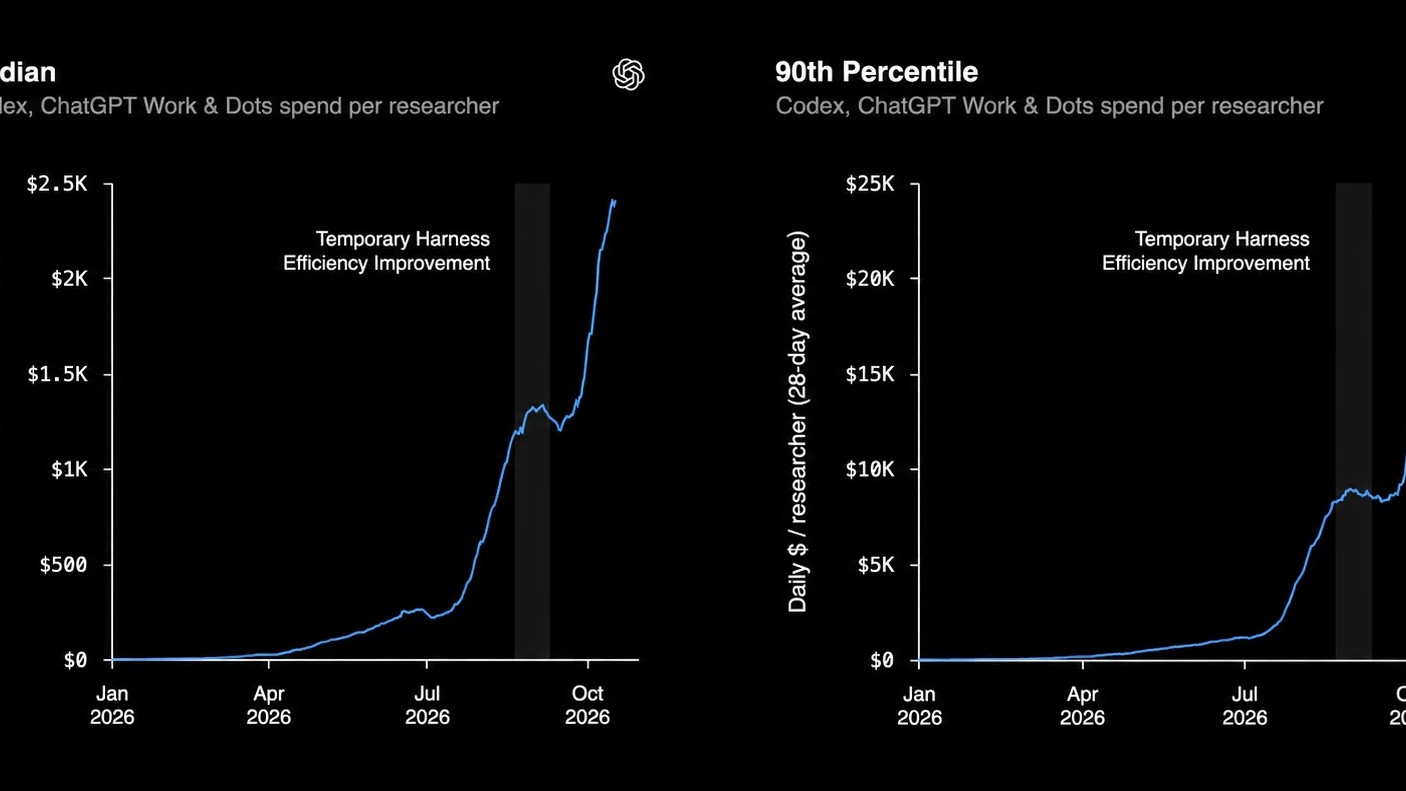
The spending numbers are the ones that will get screenshotted. Median daily agent spend per researcher reached $2,400 in October, up 62% from $1,500 in September. At the 90th percentile it hit $23,000, more than double September’s $11,000. Runtime averaged 5.7 agent workdays per researcher per day, an elevenfold increase.
For a Nigerian team, that is not a price list. Those figures are OpenAI’s own valuation of internal usage at API list prices — what the tokens would have cost at published rates — not a subscription anyone sells. No local pricing tier, naira billing or usage cap appears in the report. Reading the $2,400 as a monthly plan is a category error.
The survey result is stranger. Asked what they would trade for three months of frontier coding agents, the median of 101 researchers offered 40% of their team’s headcount, or 30% of team compute. Staff were also asked to name what agents do not do well, and the answers clustered around problem selection — deciding which question is worth asking.
Privacy and governance get thinner treatment. The published report does not set out data retention, residency or access terms for agent-generated work. That gap matters most in markets where client data crosses borders by default.
How to Use This Without Believing the Headline
Treat the 46% as a ceiling measured on a favourable task mix, then test it on your own work. Give an agent a bounded, verifiable job — monitoring a pipeline, summarising a test run, drafting a changelog — and score the output before it touches production. The categories with documented high success are precisely the ones where a reviewer can check the result cheaply.
Alternatives behave differently, and their numbers are not interchangeable. Anthropic’s own assessment put Claude at the helm of 26% of its AI research and development work in August, up from under 1% in February, using a different definition of what leading a task means. An external METR assessment published November 5 estimated that AI assistance had lifted benchmark improvement to 1.9 times the historical rate, with a confidence interval of 1.5 to 2.8, while conceding the study was not a controlled experiment and that much of the evidence had been redacted.
Even OpenAI’s headline progress metric is not a clean comparison. Its internal capabilities index rose 16.4 points a year since August 2025; Epoch AI measured 14 points a year since late 2024 on a different benchmark mix. Different rulers, similar direction. That is worth noting before anyone claims one lab is definitively ahead.
The honest reading is that OpenAI AI agents have become a real productivity tool for narrow, checkable work and remain a supervised intern for everything else. The report itself concludes that humans remain a core part of the AI research loop, and chief economist Aaron Chatterji wrote that the company needs to share data regularly so outsiders can draw their own conclusions. That invitation is the correct test: not the press release, but whether the published numbers hold up when other people rerun them.
Who should use it: teams with a defined pipeline, a reviewer with authority to reject output, and a dollar budget they can watch daily. Who should not: anyone assuming the 46% transfers to open-ended research, client-facing delivery or regulated data, or anyone who mistakes a self-reported internal metric for a product guarantee. Judge OpenAI AI agents by the corrections their output still needs — that number, not the headline, tells you what you are actually buying.
Frequently Asked Questions
Do OpenAI AI agents really complete nearly half of research tasks on their own?
On OpenAI’s own internal measure, agents completed 46% of delegated tasks estimated at two to four hours of human work in October, up from 23% in March. The report itself notes the task mix changed over that period, so better models and better delegation choices could both explain the gain. The figure covers OpenAI’s research work, not general business tasks.
Does $2,400 a day mean I need that budget to use coding agents?
No. That figure is OpenAI’s valuation of its own researchers’ agent usage at API list prices — what the tokens would have cost at published rates. It reflects very heavy internal use, with the top 10% of users at $23,000 a day. Ordinary usage is billed per token at whatever rate your provider charges, and the report describes no local pricing tier.
What are OpenAI AI agents still bad at?
The report is specific. Writing inference and serving code hit 25% autonomous success, building evaluation and reinforcement-learning environments 29%, and launching training runs 35%. Researchers also flagged weak research taste, poor code quality judgement and difficulty telling good data from bad, which is why close supervision remains necessary.
FIRST TIME REACTIONS:
Be the first to leave us a comment – OpenAI AI Agents Finish 46% of Research Tasks: What It Means, down the comment section.
JOIN US ON OUR SOCIAL MEDIA:
About Xavier Catherine
Xavier Catherine is the Technology Lead at AfriLatest. With a background in computer science and a focus on innovation, he oversees the platform's technology infrastructure. Xavier also contributes reporting on AI, gadgets, and cybersecurity, ensuring AfriLatest remains secure, reliable, and user-friendly.
View all articles by Xavier Catherine-

 Car Reviews3 weeks ago
1955 Chevy Bel Air Restomod: What SEMA Really Proves
-
Celebrities3 weeks ago
Hailey Bieber PMDD Diagnosis Followed Son Jack’s Birth
-
World News3 weeks ago
Céline Dion Air Bass At Metallica’s Sphere: What’s Confirmed
-
Nigeria News3 weeks ago
NAJA Names Weststar Chairman Auto Legend For 2026
-
Africa News4 weeks ago
Stablecoins In African Trade Gain Ground, Costs Bite
-
Sports3 weeks ago
Bronny James NBA Future: Lakers Roster Math Turns Tight