
Business & Finance
Doctors Abandon Patients At Government Specialist Hospital In Edo For The Fear of Covid-19
Doctors Abandon Patients At Government Specialist Hospital In Edo For The Fear of Covid-19

Government Specialist Hospital

Caption
Government Specialist Hospital
WATCH VIDEO: Doctors Abandon Patients At Government Specialist Hospital In Edo Over COVID-19 Fear
MORE@AFRILATEST
JOIN US ON FACEBOOK

Savings & Investing
Sustained Investment in Teacher Education: Olowolafe’s Case
Olowolafe calls for sustained investment in teacher education. A comparison of Nigeria’s funding pipeline against its digital infrastructure model.

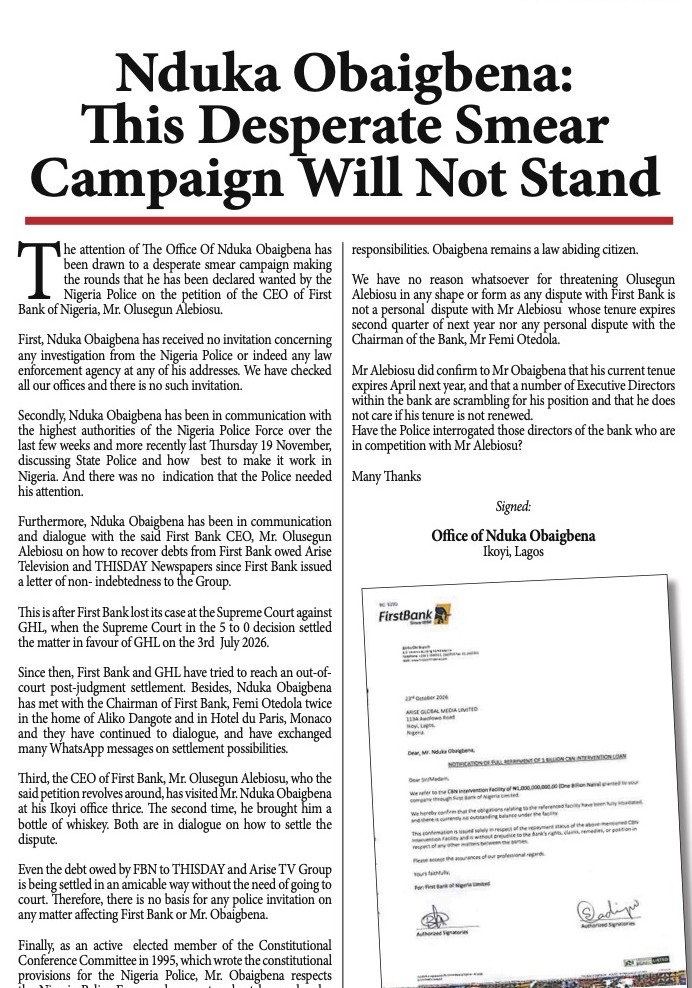
Two allocations sit inside Dr. Tunji Olowolafe’s convocation lecture, and they do not carry the same risk. One is the slow, five-year work of building teachers. The other is a solar-powered ICT centre with satellite bandwidth and someone paid to maintain it. The Chancellor of Ekiti State University wants both funded. The harder question, for anyone holding a budget line, is which one fails first when the money stops.
Olowolafe made the case for sustained investment in teacher education at the 2026 Convocation Lecture of the Sikiru Adetona College of Education, Science and Technology in Omu-Ajose, Ogun State. ThisDay reported that he called the Dual-Mandate NCE-Degree programme the most significant structural change to teacher education since the Ashby Commission of 1959. He spoke on Monday, November 23, 2026.
No financial instrument is being sold here, and no return is promised. Nothing in this analysis is personal financial advice. The lecture is better read as an argument about how public and philanthropic capital should be split between people and equipment.
What The Dual-Mandate Reform Changes, And Who Pays For It
The Federal Colleges of Education Act, signed in June 2023, allowed eligible colleges to award degrees. The Federal Ministry of Education operationalised the programme in May 2025. A student now earns the Nigeria Certificate in Education after three years and completes a bachelor’s degree in the same institution after two more.
That removes a structural ceiling. Colleges that could only issue certificates run a full pathway, which changes their ability to attract students and staff. It does not, by itself, change what happens in a classroom.
Two vehicles carry most of the money. Olowolafe said the Nigeria Tax Act 2025 strengthened education financing through the Tertiary Education Trust Fund and the Nigerian Education Loan Fund, and that NELFUND had disbursed more than N372 billion to over one million students for tuition and upkeep. PRNigeria quoted him saying about 80 per cent of SACOETEC’s buildings were funded through TETFund interventions.
The distinction matters for anyone assessing the sector. TETFund is grant capital for infrastructure. NELFUND is a loan book carried by students. One is a transfer; the other is a liability that has to be repaid.

Why Sustained Investment In Teacher Education Now Has A Deadline
Olowolafe put a date on the demand. “Nearly eight million babies will be born in Nigeria this year alone,” he said. “In 2032, those children will walk into Primary One classrooms across this country.”
Against that, he cited an estimated shortfall of about one million teachers in the basic education system. A five-year training pathway that begins today produces its first graduates after the children born this year have already started school. The pipeline is not slow by accident. It is slow by design, and the design was fixed years ago.
Risk, Diversification, Liquidity And Minimum Commitment
Risk on the teacher pipeline is attrition and continuity. A cohort that starts a five-year pathway needs funding in year one and again in year five, and budgets rarely hold that long. Risk on the infrastructure side is obsolescence and running cost. Solar arrays, bandwidth and equipment need maintenance long after the launch photograph.
Diversification is not optional here, because the two assets are correlated. An ICT centre without trained teachers sits idle. Teachers trained in digital methods without equipment teach the old way. Funding one and not the other buys a headline, not a capability.
Liquidity is the weakest attribute of both. Neither can be sold in a secondary market. Human capital walks out of the door if pay and conditions deteriorate. Hardware depreciates where it stands. Any classroom effect from children born this year runs to 2032.
Minimum commitments are where the source material goes quiet. Olowolafe disclosed no cost per trained teacher, no budget for the planned GOMTECH centre at SACOETEC, and no per-student training figure for the foundation’s existing centre in Are-Ekiti. The only hard number in the lecture was the N372 billion NELFUND disbursement. Anyone modelling this sector should treat the rest as undisclosed.
Where Returns Are Claimed, And Where The Evidence Stops
Olowolafe’s economic argument is that teaching quality determines the knowledge, skills, creativity and values available to the workforce, and that better teaching strengthens businesses and productivity. The chain is plausible. It is also unmeasured in the material released so far. No cohort completion rates, learning-outcome data or cost-per-teacher figures accompanied the lecture.
The commitments themselves are concrete. PRNigeria reported plans for a solar-powered GOMTECH Information and Communication Technology centre at SACOETEC with Starlink connectivity, to be constructed, equipped, funded and co-managed by the Tunji Olowolafe Foundation alongside the college’s Governing Council and management. Project Digi-Teach at EKSU aims to certify all 650 lecturers in digital and AI-enabled teaching. The GOMTECH centre in Are-Ekiti already trains rural schoolchildren, university students and teachers in artificial intelligence, coding, graphic design and Mandarin Chinese.
Punch reported the same announcements, including annual recognition for first-class degree graduates, NCE distinction holders and the lecturers rated highest by students. Recognition schemes shift incentives at the margin. They do not replace recurrent funding.
Olowolafe drew his own line on technology. “AI can explain a quadratic equation at midnight, but it cannot offer the steady, empathetic guidance of a caring adult,” he said. That sentence is the argument for keeping the people pipeline as the primary allocation.
Which Allocation Suits Which Funder
A government working through a tax-funded education budget should weight the teacher pipeline. Its payoff is slow and hard to photograph, but it is the only allocation that scales across a one-million-teacher gap. Leadership reported the same lecture with the same emphasis on funding, curriculum reform and technology integration.
A foundation or corporate donor should weight the equipment. A funded, co-managed ICT centre produces a visible asset in months rather than years, and the donor keeps a governance role. The trade-off is that it demands an operating budget long after the ribbon is cut.
A student should read NELFUND for what it is: a loan that eases tuition and upkeep, not a grant. Olowolafe urged SACOETEC management to guide eligible students through the application process. Borrowing to enter a profession with a one-million-person shortage is a different calculation from borrowing into a crowded field, but it is still borrowing.
For all three, the case for sustained investment in teacher education rests on a date rather than a forecast. The children born this year arrive in 2032 either way. The only variable is how many trained teachers are waiting for them.
Disclaimer: This article is for information and analysis only. It is not personal financial advice, and it does not recommend any security, fund or institution. No returns are guaranteed. Figures are as reported at the time of writing and may be revised.
Frequently Asked Questions
What is Nigeria’s Dual-Mandate NCE-Degree programme?
It is a reform enabled by the Federal Colleges of Education Act, signed in June 2023, and operationalised by the Federal Ministry of Education in May 2025. Eligible colleges of education can now award both the Nigeria Certificate in Education and bachelor’s degrees. Students take three years for the NCE and a further two years for the degree at the same institution.
How much has NELFUND disbursed to Nigerian students?
Dr. Tunji Olowolafe said in his 2026 SACOETEC convocation lecture that the Nigerian Education Loan Fund had disbursed more than N372 billion to over one million students for tuition and upkeep. The figure was reported by ThisDay, Punch, Leadership and PRNigeria.
Does this article constitute investment or financial advice?
No. No financial product is on offer and no return is promised. The article examines how public and philanthropic capital is being allocated between teacher training and education infrastructure. Readers should seek licensed professional advice for their own circumstances.
 Follow AFRILATEST on Google News
FIRST TIME REACTIONS:
Be the first to leave us a comment – Sustained Investment in Teacher Education: Olowolafe’s Case, down the comment section.
JOIN US ON OUR SOCIAL MEDIA:

About Paul Nwogo
Paul Nwogo is an engineer, published author, and the Head Manager at AfriLatest. He has written numerous books available on Amazon covering a diverse range of topics, including health, personal finance, relationships, work ethics, and scam survival. With his technical background and passion for writing, Paul now oversees the editorial direction of AfriLatest, delivering practical, accurate, and engaging content on trending news, music, and global lifestyle topics.
View all articles by Paul NwogoStock Market
Stock Market Today: Nvidia vs. An Index Fund
Stock market today: Nvidia fell 5.86% while the S&P 500 slipped 0.50%. A comparison of single-stock risk, liquidity, minimums and returns.

Two assets, one session, and two completely different experiences of the stock market today. On Tuesday, Nov. 24, 2026, an owner of Nvidia shares watched 5.86% of that position disappear by the closing bell, one day after the same stock posted its largest single-day percentage gain in more than two decades. An owner of a broad U.S. index fund watched the S&P 500 slip 0.50% to 7,201.09 while the Dow Jones Industrial Average added 423.39 points to close at 50,018.70.
Same news, same session. The outcomes were not close.
That divergence is the argument. Coverage of the stock market today is usually written about indexes and read by people who own individual securities, or who are deciding whether to buy one. The practical question for a saver, a worker with a brokerage account, or a small business owner holding idle cash is not where the market closed. It is what risk was actually taken on to get there.

What The Stock Market Today Figures Actually Reveal
According to Motley Fool’s market coverage, Nvidia closed at $155.38 after trading roughly 379 million shares, about double its three-month daily average near 183 million. Monday’s gain had been 31.48%.
The dispersion beneath the indexes was wide. Investopedia’s closing report recorded Analog Devices down 17%, Micron and SK Hynix down roughly 10% each, AMD, Intel and Marvell each down more than 8%, and the iShares Semiconductor ETF down 8%. Dell fell 11% a day after rising 20%, and Hewlett Packard Enterprise dropped 16% even after beating estimates and raising guidance. On the other side, Insmed rose 14% on a $41 billion takeover by Sanofi, while Nike and Amgen each gained more than 5%.
For the index holder, the day’s range ran from about -1.5% on the Nasdaq to +0.85% on the Dow. For the single-stock holder, two sessions produced a +31% day and a -6% day, with individual chip names moving between -17% and +20%. That range is the measurable difference between the two choices.
Risk And Diversification Before Any Discussion Of Returns
Risk here means the chance of a loss you cannot wait out, not the size of a daily move. Nvidia remains 35% below the record closing high it reached on Oct. 6, per Investopedia. An investor who bought at that high is still down 35% even after Monday’s surge. Days after its record initial public offering, Anthropic traded just under $82, below its $83 issue price, which shows that a heavily promoted new listing can break its offer level quickly.
Diversification is the mechanism that shrinks outcomes of that size. Note, though, that the semiconductor ETF fell 8% on the same day the Dow rose. A fund concentrated in a single theme removes company-specific risk and leaves theme risk fully intact.
Liquidity is where the two assets look most alike and matter least. Nvidia’s volume was roughly double normal, and index funds trade in depth. Liquidity cuts both ways: the ease of exiting is shared by everyone else trying to exit at the same moment. For a buyer funding a U.S. account from Nigeria, the binding constraints sit elsewhere, in currency conversion, cross-border funding, settlement time and broker fees. None of that appears on a price chart, and all of it reduces the return a headline percentage implies.
Minimum investment is the most concrete difference. One Nvidia share cost $155.38 at Tuesday’s close; at a broker without fractional shares, that is the entry ticket. Index exposure is bought through a fund or ETF with its own unit price, which the sources cited here do not disclose. Effort differs as well: an index position requires little monitoring, while a single-stock position requires tracking guidance, governance and policy.
Why A $200 Target Is A Scenario, Not A Forecast
Bernstein upgraded Nvidia to Outperform with a $200 price target, implying roughly 29% upside from $155.38, per Motley Fool. That is a model output, not an outcome, and the same report notes that analyst targets are far from guarantees.
The company’s reported fundamentals are strong and separate from the price action. Fiscal third-quarter revenue was $115.8 billion, up 103% year over year, with a raised fourth-quarter outlook, a 74.93% gross margin and a 0.32% dividend yield. Both facts held on the same day: excellent reported results and a 5.86% decline.

Three scenarios follow, and none is a prediction. If data-center spending holds, the analyst case is roughly met, and that depends on major technology companies maintaining AI infrastructure budgets. If spending decelerates, or if the U.S. proceeds with planned tariff increases on dozens of countries including China, as reported by the Wall Street Journal, the valuation multiple compresses regardless of revenue growth. A third path is the one CNBC reported UBS’s Mark Haefele describing: wider differentiation between platforms with visible monetization and companies dependent on debt, scarce capacity or speculative growth. SimCorp’s Diana Baechle told CNBC she expects continued volatility given so many unknowns, including the possibility of the Federal Reserve raising interest rates.
Governance belongs in the same list. Nvidia’s reinstated chief told staff on Tuesday that he is in therapy and apologized for violating the company’s code of conduct, per the Journal. Strategy Asset Managers’ Tom Hulick told CNBC that Huang was probably the right person to lead the firm for now, but that governance remains a concern. An index holder absorbs that issue at its weight in the benchmark. A single-stock holder absorbs it whole.
Which Asset Suits Which Holder
The index route fits the saver who cannot monitor a position daily and who needs a drawdown they can sit through without selling. The single stock fits an investor who can size the position so that a 35% decline is survivable, and who accepts that a $200 target may arrive in a year, in three years, or not at all.
Neither path is guaranteed. The stock market today delivered one asset a historic rally and a sharp reversal inside 48 hours, and that is the honest measure of what a forecast is worth at the level of an individual portfolio. Readers should treat every figure above as a dated observation, not as advice, and should confirm broker minimums, fees and currency costs before committing capital.
Frequently Asked Questions
Did Nvidia’s fundamentals weaken on Nov. 24, 2026?
The reported figures did not weaken. Nvidia disclosed fiscal third-quarter revenue of $115.8 billion, up 103% year over year, and raised its fourth-quarter outlook. The 5.86% share price decline reflected a reversal after Monday’s 31.48% rally rather than a change in reported results, which is why the article separates company fundamentals from short-term price action.
Why can a semiconductor ETF fall almost as much as a single chip stock?
Because a sector fund removes company-specific risk but keeps theme risk. On Nov. 24, 2026 the iShares Semiconductor ETF fell 8% while the Dow Jones Industrial Average rose 0.85%. Diversification across hundreds of companies in different industries produced a different result from diversification across one industry.
Does a $200 analyst price target mean a stock will reach $200?
No. A target is an analyst’s model output based on stated assumptions about growth, spending and valuation. Bernstein’s $200 target on Nvidia implied about 29% upside from the $155.38 close, but the article presents it as one scenario among several, including cases where data-center spending slows or tariff increases compress the multiple.
FIRST TIME REACTIONS:
Be the first to leave us a comment – Stock Market Today: Nvidia vs. An Index Fund, down the comment section.
JOIN US ON OUR SOCIAL MEDIA:
About Paul Nwogo
Paul Nwogo is an engineer, published author, and the Head Manager at AfriLatest. He has written numerous books available on Amazon covering a diverse range of topics, including health, personal finance, relationships, work ethics, and scam survival. With his technical background and passion for writing, Paul now oversees the editorial direction of AfriLatest, delivering practical, accurate, and engaging content on trending news, music, and global lifestyle topics.
View all articles by Paul NwogoBusiness & Finance
HIV Funding Cuts: What the $4.3bn Gap Really Costs
UNAIDS says HIV funding cuts left a $4.3bn annual gap in 2025. Nigeria relies on donors for 98% of its HIV resources. What that means for patients.
UNAIDS put a number on the table on 24 November 2026: US$4.3 billion a year. That is the annual gap left by HIV funding cuts between what low- and middle-income countries have and what they need to stay on track to end AIDS as a public health threat by 2030.
The parties to this transaction are the United States government, the Global Fund to Fight AIDS, Tuberculosis and Malaria, a long list of finance and health ministries, and thousands of community organisations that carry the last mile of testing, prevention and adherence support. The document is the agency’s new report, Ending AIDS Starts with Access, published to mark UNAIDS’ 30th year.
The money has already moved. According to UNAIDS, resources available in low- and middle-income countries fell by more than US$1 billion in 2025. Reporting on the same release, IOL notes that international HIV financing dropped 18% over the past year, that US contributions fell 26% between 2024 and 2025, and that Global Fund disbursements were down 13%.
Read as a funding story, that is a steep down round for a 25-year-old enterprise serving 40 million people.
Why HIV Funding Cuts Hit Nigeria Harder Than Most
Nigeria is the clearest test case. THISDAYLIVE reports that external resources account for approximately 98% of the country’s HIV funding, and the UNAIDS report puts donor money at 98% of all reported prevention spending as well. Mozambique sits at 94%, Uganda at 80%. Western and Central Africa as a whole depend on external funding for roughly 90% of HIV treatment.
The distinction between funding raised and revenue is not academic here. A grant is a financing event. Revenue is what recurs after the funder leaves. Nigeria’s HIV response has almost no revenue line of its own; nearly the entire prevention budget is somebody else’s appropriation. When that appropriation is cut, there is no demand curve to fall back on, no pricing power, no paying customer base.
This is the error that flatters startup reporting everywhere: money raised is treated as money earned. For a household in Kano or Kisumu, the number that matters is not the global US$4.3 billion gap. It is whether the clinic opens, whether the outreach worker still has a job, and whether the test is free.
The Burn Rate Behind The Prevention Collapse
The HIV funding cuts show up first in the operating metrics, and those metrics are deteriorating.
Access to oral PrEP fell by roughly 446,000 people in 2025 across reporting countries. Among sex workers it dropped 59%, among people who inject drugs 58%, among transgender people 23% and among gay men and other men who have sex with men 17%. UNAIDS estimates more than 20 million people will need PrEP by 2030; 2.6 million had access in 2025.
Condom distribution fell from 3 billion to 2.7 billion between 2024 and 2025. Voluntary medical male circumcision procedures dropped 53% across priority countries.
Community organisations absorbed the shock without reserves. A study cited in the report found more than three-quarters of surveyed civil society organisations reported service disruptions, and more than 80% were operating at less than half capacity by the end of 2025.
That is what a burn rate looks like in a sector with no balance sheet. Rent, salaries and fuel get cut first, and the staff who leave take their relationships with them. “Community organizations are not an optional extra,” said Winnie Byanyima, UNAIDS Executive Director. They are often the only trusted bridge between health systems and the people most at risk of HIV.
Funding Raised Is Not Revenue In The 2030 Arithmetic
The fiscal position of recipient countries explains why replacement money is not arriving. UNAIDS reports that in many highly affected countries, debt-servicing obligations now exceed government health spending by two- or even three-fold. Data from 55 countries shows domestic HIV spending did rise in response to the crisis, but not fast enough or large enough to cover the withdrawal.
The damage is also lagged, which makes the headline health statistics read better than the underlying business. UNAIDS says its current estimates do not yet capture the full effect of the 2025 disruptions, because falling out of care and losing prevention access takes time to register as infection and death.
The official numbers: about 570,000 AIDS-related deaths in 2025, roughly 1,600 a day, down from 600,000 in 2024 and 1.3 million in 2010. New infections were 1.2 million in 2025, against 3.5 million at the 1994 peak. Those are real gains. They are also trailing indicators.
Leading indicators point the other way. An estimated 3.4 million people were living with advanced HIV disease in 2025, about 8% of all people living with HIV, and a review found one in eight died within a year of presenting, most within three months. CD4 testing fell 35% between 2024 and 2025 across six countries; viral load testing fell between 16% and 68%.
“The world is sleepwalking into a preventable crisis,” Byanyima said. “We know what happens when HIV prevention collapses. People become infected, treatment needs rise, costs soar and lives are lost.”
Who Wins
UNAIDS maintains the 2030 target is still reachable, and puts the prize at 3.2 million new infections prevented and 1.3 million AIDS-related deaths averted by the end of the decade. That is the only defensible return on investment in this story, and it depends on a shift the report repeats: domestic financing treated as a permanent budget line, services folded into national health systems, and community organisations funded as delivery infrastructure rather than discretionary projects.
The winners of the next phase will be the countries that convert donor dependence into budget lines before the donors finish leaving. The losers will be those that wait for the death toll to prove the case. HIV funding cuts have already been booked. The open question is which health systems remain standing once the service disruptions finish working through the data.
Frequently Asked Questions
How big is the HIV funding gap UNAIDS reported?
UNAIDS puts the annual gap at US$4.3 billion between resources available in low- and middle-income countries and what is needed to stay on track to end AIDS as a public health threat by 2030. Resources available in those countries fell by more than US$1 billion in 2025.
Why is Nigeria more exposed than other countries?
External resources account for approximately 98% of Nigeria’s HIV funding and 98% of reported prevention spending, according to the UNAIDS report. That leaves almost no domestic revenue line to absorb a donor withdrawal, unlike countries with larger domestic financing.
Is the 2030 target still achievable after the cuts?
UNAIDS says yes, if governments strengthen domestic financing, protect community services and remove access barriers. It estimates hitting the target would prevent 3.2 million new HIV infections and avert 1.3 million AIDS-related deaths by the end of the decade.
FIRST TIME REACTIONS:
Be the first to leave us a comment – HIV Funding Cuts: What the $4.3bn Gap Really Costs, down the comment section.
JOIN US ON OUR SOCIAL MEDIA:
About Paul Nwogo
Paul Nwogo is an engineer, published author, and the Head Manager at AfriLatest. He has written numerous books available on Amazon covering a diverse range of topics, including health, personal finance, relationships, work ethics, and scam survival. With his technical background and passion for writing, Paul now oversees the editorial direction of AfriLatest, delivering practical, accurate, and engaging content on trending news, music, and global lifestyle topics.
View all articles by Paul Nwogo-

 Car Reviews3 weeks ago
1955 Chevy Bel Air Restomod: What SEMA Really Proves
-
Savings & Investing4 weeks ago
Hidden Medicare Fees Draining Your Retirement Savings
-
AI & Technology4 weeks ago
AI Scam Protection in 2026: What Actually Works
-
Health and Fitness4 weeks ago
Medicare 2027 Changes: Costs, Drug Prices and What to Do
-
Celebrities4 weeks ago
Celebrity Traitors Final Predictions: Ex-Players On Tactics
-
Celebrities3 weeks ago
Hailey Bieber PMDD Diagnosis Followed Son Jack’s Birth












Dorcas Babalola
May 4, 2020 at 2:27 am
This is a serious case
Mgbemena chukwuemeka
May 7, 2020 at 8:20 am
What will somebody not hear in Nigeria
Mgbemena chukwuemeka
May 7, 2020 at 8:21 am
God help us
Anyanwu Bright
May 7, 2020 at 2:52 pm
The truth is our doctors are trying alot it’s not easy . They are scared now
Anyanwu Bright
May 7, 2020 at 2:52 pm
God please protect Dem for us