Study & Education
3 European Universities Training Multidisciplinary Engineers
Birmingham City, Aalborg and Semmelweis are training multidisciplinary engineers through STEAM curricula, joint degrees and project frameworks.


Three European universities are pursuing the same objective — training multidisciplinary engineers — through three different structures: a STEAM curriculum at Birmingham City University, a research-tested project framework at Aalborg University, and a joint health-engineering degree run by Semmelweis University in Budapest with John von Neumann University in Kecskemét.
There is no single announcement behind this. None of the three institutions issued a joint statement and no shared European programme exists. The evidence sits in three separate published accounts, and the detail in them is what separates a working interdisciplinary degree from a slogan.
Birmingham City University’s account comes from Hanifa Shah, its pro vice-chancellor for research, enterprise, engagement and STEAM, writing for Times Higher Education. Aalborg’s comes from the InterPBL project, funded by the Grundfos Foundation, summarised by Anette Kolmos, Jette Egelund Holgaard and Henrik Worm Routhe in Open Access Government. The Semmelweis degree is described in a separate Times Higher Education campus piece.

Each describes mechanics rather than mission statements: which modules carry the interdisciplinary load, which institution owns the student record, how the teaching week is divided.
Why Training Multidisciplinary Engineers Starts With The Timetable
The Semmelweis arrangement is the most concrete of the three. The digital dental design bachelor’s degree, launched in 2022 with the John von Neumann University of Kecskemét, runs six semesters and 180 credits. It is taught part-time: one week of face-to-face classes per month during term.
The split of that teaching week is fixed. Sixty-six per cent is medicine and healthcare, delivered by Semmelweis. Thirty-four per cent is basic engineering, delivered by John von Neumann.
Two administrative decisions make the split survivable. The first is a formal cooperation agreement between the two universities, under which Semmelweis manages the aggregated subject data for each student, a common final examination system is established, and the diploma thesis procedure is synchronised. Without that, a student is enrolled at two institutions and owned by neither.
The second is optional stacking. Students decide at enrolment whether to spend the remaining three weeks of each month at the Bókay School, Semmelweis’s dental technician course. Those who opt in can graduate with a dental technician qualification and a digital dental designer degree at the same time. Students who do not opt in can work alongside their studies, which the part-time format allows.
The infrastructure arrived before the students. Computer workstations, intraoral scanners, CAD software, milling units and 3D printers were installed first, and the same equipment now serves undergraduate and postgraduate dental students as well as the digital design cohort.
Aalborg And Birmingham Built The Institutional Machinery
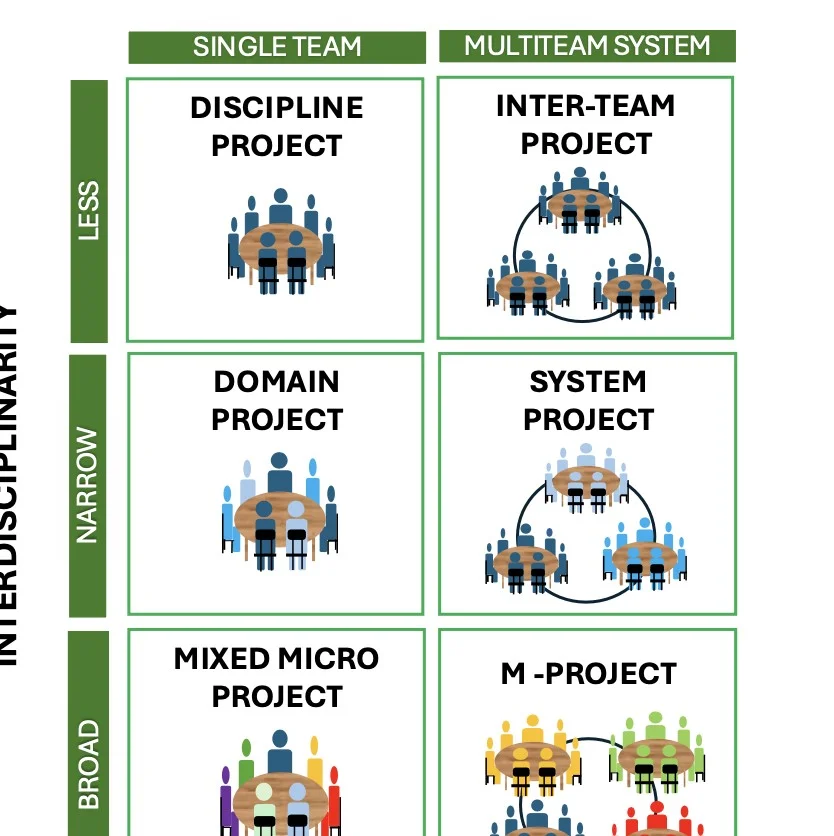
Aalborg’s InterPBL project started from a correction. The researchers found that earlier approaches to interdisciplinary projects were too simplistic because they treated interdisciplinary work as a single category. The project built a framework of six categories of disciplinary and interdisciplinary problem-based projects, defined along two dimensions: the type of knowledge involved, ranging from a single discipline to narrow and broad interdisciplinary problems, and the collaboration pattern, from a single student team to multi-team arrangements.
The distinction between narrow and broad interdisciplinarity carries weight. Greater distance between disciplines creates more difficulty in understanding scientific knowledge, along with cultural and pedagogical differences between the fields.
Aalborg’s central finding cuts against a common fear. Interdisciplinary collaboration does not mean an absence of disciplinary knowledge. The researchers report the reverse — students gain a better understanding of their own field (Routhe et al., 2023). What they also learn is where their expertise stops being useful to a collaborator.
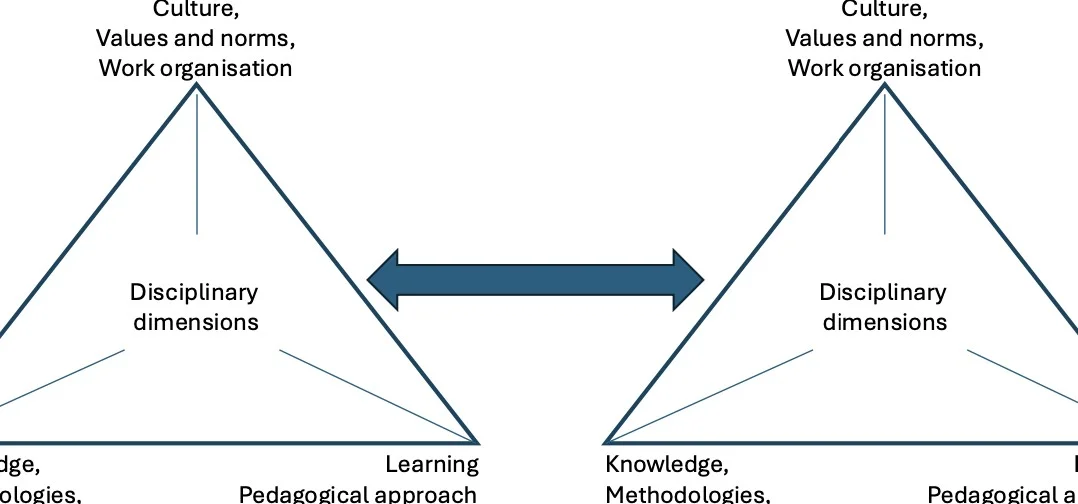
A second finding concerns scale. In multi-team system projects, project management tools were not enough. Students moved from applying project management tools to exercising leadership (Routhe et al., 2024), which required common visions, common knowledge bases and shared approaches to learning across teams. Three dimensions explained the variation in how students worked: knowledge, learning and culture.
Birmingham City’s contribution is the question of who is accountable. Shah lists the posts the university created to carry the STEAM agenda: a pro vice-chancellor for STEAM and interdisciplinary education, a director of interdisciplinary research and innovation, a director of innovative pedagogy, a STEAM integration lead in each faculty, a head of experiential and applied learning, and student STEAM champions.
The curriculum follows the same pattern. A collaborative project-based module sits at Level 4, with students building on it through Level 5 and Level 6 modules. The university runs micro-placements, student start-ups, joint lab sessions with businesses and live projects with public and private sector bodies, and hosts an annual Innovation Fest where student work is demonstrated. Shah argues explicitly that these priorities are about producing work-ready graduates through industry-informed teaching.
What The Chennai Merger Reveals About The Word Multidisciplinary
The three European cases become clearer against a non-European comparison sitting in the same source pool. SSN College of Engineering in Chennai applied for and received approval in September 2025 for a progressive closure from the 2026-27 academic year, as part of a phased merger into Shiv Nadar University Chennai. The stated aim, as reported by the Times of India, is to consolidate engineering education under one multidisciplinary university framework.
The measurable changes are in access and cost, not in curriculum design. Under the old route, seats were allocated through Tamil Nadu Engineering Admissions centralised counselling on Class 12 Physics, Chemistry and Mathematics marks, with no interview. Government quota tuition was ₹50,000 per year for non-accredited courses and ₹55,000 for accredited ones; management quota was ₹1,40,000 and ₹1,45,000 respectively. Under Shiv Nadar University Chennai’s published 2026-27 fee table, B.Tech tuition for Indian nationals is ₹3,50,000 per year for CSE, IT, ECE, EEE and AI and Data Science, and ₹3,00,000 for Mechanical, Civil, Chemical and Biomedical, before hostel and transport.
The contrast is the point. In Chennai, multidisciplinary is an institutional consolidation whose visible effects land on entry routes and fees. In Birmingham, Aalborg and the Semmelweis-John von Neumann partnership, it is a curriculum and governance construct whose effects land on timetables, credit splits and who holds the student record. When a ministry, regulator or vice-chancellor announces a push for training multidisciplinary engineers, the useful question is which of those two mechanisms is actually being proposed.
What To Watch
The published material contains no completion rates, no graduate employment data and no enrolment figures for any of the three programmes. Shah’s essay is an argument for a model, not an evaluation of it. Aalborg’s is a research framework. Semmelweis’s is a programme description. Any claim that these approaches improve employment outcomes for engineers remains untested in the sources cited here.
Watch three indicators. First, whether Aalborg’s six-category framework is adopted by institutions outside Denmark, which would show the narrow-versus-broad distinction travels. Second, whether the 66-34 medicine-to-engineering split at Semmelweis is replicated in other health-technology degrees, or stays a single case. Third, whether Birmingham’s named STEAM roles outlast the vice-chancellor who created them — the most common failure point for interdisciplinary reform.
Frequently Asked Questions
Which European universities are training multidisciplinary engineers?
Three documented examples are Birmingham City University, which runs a STEAM-based curriculum; Aalborg University in Denmark, whose InterPBL project produced a framework for interdisciplinary problem-based engineering projects; and Semmelweis University in Budapest, which runs a joint digital dental design bachelor’s degree with John von Neumann University of Kecskemét.
How is the Semmelweis digital dental design degree structured?
It runs six semesters and 180 credits, taught part-time with one week of face-to-face classes per month. Sixty-six per cent of teaching is medicine and healthcare delivered by Semmelweis, and 34 per cent is basic engineering delivered by John von Neumann University. A cooperation agreement makes Semmelweis responsible for aggregated student subject data and sets a common final examination and synchronised diploma thesis procedure.
Does interdisciplinary engineering education reduce disciplinary knowledge?
Aalborg University’s InterPBL researchers report the opposite. Their findings state that interdisciplinary collaboration allows students a better understanding of their own field, and that students gain rather than lose disciplinary knowledge. What students also learn is the limits and opportunities of collaborating across knowledge boundaries.
Receive alerts for training multidisciplinary engineers and more like it.
 Follow AFRILATEST on Google News
FIRST TIME REACTIONS:
Be the first to leave us a comment – 3 European Universities Training Multidisciplinary Engineers, down the comment section.
JOIN US ON OUR SOCIAL MEDIA:

About Rosabella Eboh
Rosabella Eboh is an author at AfriLatest. With a passion for writing and a flair for creativity, she contributes original content and unique perspectives to the platform. Rosabella focuses on human-interest stories, cultural trends, and in-depth feature reporting.
View all articles by Rosabella Eboh

Study & Education
Airtel School Adoption Programme: Verify Outcomes
Airtel school adoption programme expands access in Nigeria, but verified outcomes depend on cost, teacher training, device use and learning data.

The goal is to test corporate school adoption by verified effects on learners, educators, household costs, access and outcomes. The Airtel school adoption programme is a useful case because it combines connectivity, devices, zero-rated data and infrastructure rehabilitation. That mix can widen access. It does not, by itself, prove that children learn more.
Vanguard’s September 2026 report says Airtel’s five-year UNICEF partnership under Reimagine Education has provided broadband connectivity, digital devices and zero-rated data access to public primary schools nationwide. It targets more than 300,000 students across hundreds of schools. Pupils and teachers get free access to the Nigeria Learning Passport and YOMA, alongside Airtel’s Adopt-a-School infrastructure rehabilitation projects, according to Vanguard.
The claim is concrete on inputs. It is silent on the variables that decide whether adoption becomes education: devices per pupil, teacher training hours, usage frequency, maintenance, cost per school and learning assessments. Those gaps are not minor. They separate a rollout from a result. The word sustained should also be tested over at least one academic session, not a single handover event.

Why The Airtel School Adoption Programme Needs A Learner-Level Audit
Start with learners, not logos. A school can be adopted and still have one charged device locked in an office. Ask how many pupils have regular, timetabled access; how many devices work on a normal school day; and whether the Nigeria Learning Passport is used in class or only named in a press release. The Vanguard report gives a target of more than 300,000 students but not active users.
Then check educators. The same report gives MTN a hard teacher-training number: 8,702 public primary and secondary teachers trained under the SAIL Teachers’ Fellowship since 2024. It gives no comparable Airtel teacher-training count. That asymmetry matters because devices and free data do not teach by themselves. A programme that does not publish teacher numbers, training hours and follow-up coaching cannot show sustained classroom change.
Use NCC Whitelisting And The 100MB Cap To Test Access Claims
The official policy boundary is clear. The NCC’s zero-rated data initiative gives eligible users up to 100MB daily to approved and whitelisted educational platforms, or about 3GB a month subject to the daily limit. The NCC and Federal Ministry of Education must approve the platforms. That is a bounded benefit: it covers selected learning sites, not the open internet, and it still requires a device, power and a teacher who can use the content.

Costs need the same discipline. A zero-rated page is not free if the family must buy a smartphone or pay for charging. The Guardian’s 2018 account of low-cost private schools in Lagos shows how price-sensitive the market is: operators charged from N2,000 to N18,000 per term, and the DEEPEN programme estimated that private provision saved Lagos N377bn from 2010 to 2015, according to The Guardian. The comparison is not exact, but it sets the test: corporate adoption should show whether it lowers the household cost of access or shifts it.
What A Verified School Adoption Programme Must Publish
A verified programme should publish four numbers every term: active pupils per school, working devices per pupil, teacher training hours completed, and cost per pupil to the operator and to the household. It should also publish a learning measure, even a simple baseline and endline reading or numeracy check. Without these, adoption is a procurement and publicity claim.
Regulators can help by requiring standard reporting from zero-rated platform providers: whitelisted platform names, daily active users, session length and school-level reach. Schools can help by keeping a simple log of device use and teacher absence from digital lessons. Neither step is expensive. Both make claims checkable.
The action step for the Airtel school adoption programme is to publish school-level access, cost and learning data before it asks the public to treat adoption as sustained education. The same rule applies to every telecom-funded school programme in Nigeria. Count the learner, the teacher and the household cost first. Then count the press release.
Frequently Asked Questions
What does the Airtel school adoption programme actually provide?
The source material says Airtel’s five-year UNICEF partnership under Reimagine Education provided broadband connectivity, digital devices and zero-rated data access to public primary schools, targeting more than 300,000 students across hundreds of schools. It also provides free access to the Nigeria Learning Passport and YOMA, alongside Adopt-a-School infrastructure rehabilitation projects. The source does not publish learning outcome data.
How should parents and teachers verify school adoption claims?
Check whether the digital platform is approved and whitelisted by the NCC and Federal Ministry of Education. Ask for active pupil numbers, working devices per pupil, teacher training hours, usage logs and cost per pupil. A claim without school-level data is an input claim, not proof of learning.
Does zero-rated data remove the cost barrier for learners?
No. The NCC initiative gives eligible users up to 100MB daily to approved educational platforms, or about 3GB a month subject to the daily limit. It covers selected platforms, not the open internet, and it still requires a device, power and teacher support. Household costs can remain.
FIRST TIME REACTIONS:
Be the first to leave us a comment – Airtel School Adoption Programme: Verify Outcomes, down the comment section.
JOIN US ON OUR SOCIAL MEDIA:
About Rosabella Eboh
Rosabella Eboh is an author at AfriLatest. With a passion for writing and a flair for creativity, she contributes original content and unique perspectives to the platform. Rosabella focuses on human-interest stories, cultural trends, and in-depth feature reporting.
View all articles by Rosabella EbohJAMB & WAEC
JAMB Admission Process: What Changed And What Is Still Talk
JAMB admission process gets clearer status updates and easier record fixes. Here is what is live, what is still a proposal, and what candidates should do.

The Joint Admissions and Matriculation Board has moved to end the guessing game that follows every admission cycle, announcing changes to how candidates view their status and correct their records. Registrar Segun Aina disclosed the measures on Wednesday at the board’s Abuja Zonal Office during an interaction with UTME candidates, part of JAMB’s 2026 Customer Week.
The centrepiece is information. Candidates checking their status had long met two dead ends: “not admitted” or “admission in progress”. Neither explained whether an application had been shortlisted, was waiting on a departmental quota, or had failed outright. The board now says the JAMB admission process will display detailed progress on each application.
“Instead of just seeing ‘not admitted’ or ‘admission in progress’ and just waiting and being nervous and being traumatised, we now have a situation where you can see the details,” Aina said, as Vanguard reported.

Two further fixes accompany that. Candidates who lose access to the phone number or email address registered with JAMB can now update them, where those details previously locked them out of their own accounts. Name and personal-detail corrections, tightly restricted once a candidate entered the admission system, are now handled through closer collaboration with the National Identity Management Commission.
The flexibility is fenced. Aina said anyone altering identity to gain admission fraudulently would face prosecution. “If you are trying to take advantage of the system, please get ready. You will be feeling the full weight of the law in due course.”
What The JAMB Admission Process Changes Actually Deliver
The announcement bundles three things at very different stages, and treating them as one reform overstates what is running today.
The status upgrade and the contact-detail updates are presented as deployed. JAMB published no timeline, no description of the new interface and no figures on how many candidates have used it. The name-correction route is live only in the sense that it depends on NIMC records matching JAMB’s — and that matters, because the JAMB admission process now leans on a second agency as a verification layer rather than a formality.
The third item is not a policy. It is a committee.
Critical Thinking Is A Committee, Not A Requirement
Aina confirmed that a panel headed by the psychometrician Prof. Boniface Nworgu is examining whether critical thinking and life skills can be assessed within JAMB’s examinations. No final decision has been taken. If the committee recommends adoption and management approves, a separate panel of experts would then build an implementation framework.
He offered medicine as the illustrative case: a doctor needs judgement and an understanding of consequences, not only recall of facts. The logic is defensible. The status is not yet.
Candidates preparing for the 2027 UTME should not rebuild their study plans around a test that may never be written. JAMB’s own framing is that any additional assessment would complement, not replace, UTME subjects and O’level requirements, as Tribune Online reported. Until a circular is issued, the syllabus stands.
Transparency Eases Anxiety, Not Scarcity
The harder constraint sits underneath the customer service. JAMB coordinates admission; it does not create places. Institutions set cut-offs, quotas and programmes, and the board polices the interaction between them and applicants.
“The people we serve don’t need to know anybody to get admission. It is our job to stand and moderate the interaction between these candidates and the institutions, and make sure they get their rightful places in the universities,” Aina said.
Clearer status messages shorten the period of not-knowing. They do not alter the ratio of applicants to available places, and JAMB did not publish that ratio at the briefing. That missing number is the honest measure of how far this week’s announcement reaches a candidate competing for a seat that is simply not there.
Two side decisions carry real operational weight. Aina defended the harmonised examination timetable, conceding it can shorten JAMB’s preparation window but arguing it protects result-release timing so institutions can admit on schedule. Separately, the board will open a UTME centre in Ottawa for the 2027 cycle, describing the exam’s presence in about ten foreign countries, and in correctional service centres, as access measures rather than revenue ones, The Sun reported.
What Candidates Should Do Now
Confirm every detail on your JAMB profile before the registration window closes. A misspelt name that matches your NIMC record is easier to defend than one that does not.
If you have lost the phone number or email address you registered with, use JAMB’s official update channel rather than creating a second profile. Duplicate records are exactly what the identity checks are built to catch.
Read your status page in full, not only the headline word. Where a message is still vague, log a complaint through the board’s official channels and keep the reference number.
Above all, treat the JAMB admission process as something you verify yourself. Anyone asking for money on the promise of influencing admission is selling a service the board says it actively polices against. The registrar’s warning cuts in both directions — at fraudsters, and at candidates tempted to become one.
Frequently Asked Questions
Has JAMB actually introduced a critical thinking test for the UTME?
No. The registrar said a committee headed by Prof. Boniface Nworgu is examining whether critical thinking and life skills can be measured reliably. No final decision has been taken, and any adoption would require management approval followed by a separate expert panel to design the implementation framework. Candidates should continue preparing for the existing UTME subjects and O’level requirements.
Can I still change my name or personal details on my JAMB profile?
JAMB says corrections are now possible through closer collaboration with the National Identity Management Commission, after a period when such changes were restricted to prevent identity manipulation. The board warned that anyone using the process to falsify identity will face legal consequences, so corrections should match your NIMC records.
What should a candidate do if they have lost the phone number or email used for registration?
JAMB says it has deployed technology allowing candidates to update registered telephone numbers and email addresses. Candidates should use the board’s official update channel rather than opening a second profile, since duplicate records are the pattern its identity checks are designed to detect.
Receive alerts for JAMB admission process and more like it.
FIRST TIME REACTIONS:
Be the first to leave us a comment – JAMB Admission Process: What Changed And What Is Still Talk, down the comment section.
JOIN US ON OUR SOCIAL MEDIA:
About Rosabella Eboh
Rosabella Eboh is an author at AfriLatest. With a passion for writing and a flair for creativity, she contributes original content and unique perspectives to the platform. Rosabella focuses on human-interest stories, cultural trends, and in-depth feature reporting.
View all articles by Rosabella EbohStudy & Education
FG Harmonises 2027 Exam Timetable For WAEC, NECO
The FG’s harmonised 2027 exam timetable targets August results and September admissions. What is confirmed, what is only proposed, and what it costs candidates.

The reputation of Nigeria’s external examination calendar rests on one unwelcome certainty: results arrive late, and admissions slip behind them.
The Federal Government wants to end that. A harmonised 2027 exam timetable, announced through the Federal Ministry of Education, proposes that WAEC, NECO, NABTEB and NBAIS release results by August 2027, clearing the way for tertiary admissions to open in September.
The plan was disclosed in a statement by the ministry’s Director of Press and Public Relations, Boriowo Folasade, after the Minister of State for Education, Prof. Suwaiba Sa’id Ahmad, met heads and representatives of the examination bodies at the ministry’s Abuja headquarters.

Read as a scheduling document, the 2027 exam timetable is tidy. Read as policy, it is a test of whether one ministry can hold five independent examination bodies to a shared deadline. The published details show how much of that test remains unanswered.
What The 2027 Exam Timetable Actually Sets Out
The Joint Admissions and Matriculation Board would run the Unified Tertiary Matriculation Examination from 15 to 25 March 2027, with results expected inside the same month.
NECO’s Senior School Certificate Examination occupies 1 April to 14 May. WAEC’s West African Senior School Certificate Examination runs 11 May to 18 June. NABTEB sits 1 June to 5 July, and NBAIS 10 June to 9 July. Results for those four are targeted for August.
The Guardian reported the same sequence, attributing it to the ministry’s late-Wednesday statement. Vanguard noted that the arrangement places the examination bodies under pressure to complete processing in time to meet the August target. Edugist dates the press release to 14 October 2026.
Two Overlaps The Harmonisation Leaves Standing
Simple arithmetic on the published dates exposes the first gap. NECO’s window closes on 14 May. WAEC’s opens on 11 May. A candidate entered for both faces four days of collision in the middle.
The second gap runs longer. NABTEB closes on 5 July while NBAIS opens on 10 June. The two windows intersect for roughly four weeks.
Body-level windows do not settle paper-level clashes, and the ministry’s statement frames clash-prevention as an aim rather than a completed outcome. Which papers move, and by how much, does not appear in the announcement. Until the individual papers are published, a candidate planning two entries is planning blind.
Proposal, Not Implementation
The distinction that matters most sits in a single line of reporting. Edugist notes that the ministry has not indicated whether the proposed timetable has received final approval from all the examination bodies.
The statement itself calls the dates proposed timelines. It names no penalty, sanction or fallback for a body that misses August. Compliance rests on continued engagement, a phrase the ministry used repeatedly, and on what it described as strengthened accountability.
Those are intentions. A published target with no consequence attached is a planning aid, not a guarantee.
Marking and moderation take as long as they take. Compressing a calendar does not by itself compress the script-processing chain, and the ministry has not published the capacity measures that would.
Candidates act on dates anyway. Accommodation is rented, offers are declined, a session is deferred, all on the strength of a calendar that for now exists only as a proposal.
What Changes For Candidates, Schools And Parents
TVC News reported that the UTME slot is earlier than usual, meaning registration and preparation shift forward, and that schools and tutorial centres will likely adjust their academic calendars in response.
Cost is the category the announcement touches only indirectly. No registration fee change was announced. What a fixed calendar changes is timing: parents can budget earlier for fees, mock examinations, transport and accommodation instead of absorbing them in an unpredictable cluster.
Access may prove the larger effect. Folding NABTEB and NBAIS into the same August results window brings technical, business, Arabic and Islamic studies candidates onto an admission timeline long dominated by conventional school leavers. That is the most consequential element of the plan, and the least discussed.
Outcomes remain the weakest link. A timetable does not teach anything. It does hand teachers a fixed revision horizon and give students a date to work backwards from, which is worth less than instruction and more than nothing.
The reform sits under the Nigeria Education Sector Renewal Initiative, the agenda of the Minister of Education, Dr Maruf Tunji Alausa.
Is The 2027 Exam Timetable The Right Fit?
For a candidate, the answer depends on how the 2027 exam timetable is used. Treated as a registration notice, it will mislead. Treated as a planning guide while the official timetables from JAMB, WAEC, NECO, NABTEB and NBAIS are awaited, it is among the more useful documents the ministry has issued.
The proposal earns its value only if August holds. It earns nothing if August slips after students have already planned around it.
Frequently Asked Questions
Have the 2027 WAEC, NECO and JAMB dates been confirmed?
No. The Federal Ministry of Education described the dates as proposed timelines. Edugist reported that the ministry has not indicated whether the proposed timetable has received final approval from all the examination bodies. Candidates should wait for official registration notices and final timetables from each body.
When will 2027 WAEC and NECO results be released?
The government is targeting August 2027 for the release of NECO, WAEC, NABTEB and NBAIS results, with JAMB UTME results expected in March 2027. These are targets, not published commitments with any stated penalty for missed deadlines.
Do NECO and WAEC timetables clash in 2027?
On the published dates, yes. NECO’s window closes on 14 May 2027 and WAEC’s opens on 11 May 2027, so the two intersect for four days. Whether individual papers collide depends on timetables that have not yet been released.
FIRST TIME REACTIONS:
Be the first to leave us a comment – FG Harmonises 2027 Exam Timetable For WAEC, NECO, down the comment section.
JOIN US ON OUR SOCIAL MEDIA:
About Rosabella Eboh
Rosabella Eboh is an author at AfriLatest. With a passion for writing and a flair for creativity, she contributes original content and unique perspectives to the platform. Rosabella focuses on human-interest stories, cultural trends, and in-depth feature reporting.
View all articles by Rosabella Eboh-

 Startups1 month ago
What a Successful Dangote Refinery IPO Really Says
-
Health and Fitness2 weeks ago
Curly Hair Hydration: 5 Proven Steps That Actually Work
-
Savings & Investing3 days ago
Hidden Medicare Fees Draining Your Retirement Savings
-
Tech & Gadgets3 weeks ago
Apple Watch and AirPods Fall Deals: Save $120 Today
-
Football1 month ago
South Carolina vs Alabama: Tide Roll to 35-10 Halftime Lead
-
University Admissions1 month ago
UNILAG 2026/2027 Admission: Direct Entry & Post-UTME Guide
-
Trending Entertainment News3 weeks ago
Taylor Swift Joins Beatles as Only Acts With 100 Weeks at No. 1
-
Football1 month ago
Mexico vs Colombia 2026: Márquez Debut Ends in Defeat