Study & Education
3 European Universities Training Multidisciplinary Engineers
Birmingham City, Aalborg and Semmelweis are training multidisciplinary engineers through STEAM curricula, joint degrees and project frameworks.


Three European universities are pursuing the same objective — training multidisciplinary engineers — through three different structures: a STEAM curriculum at Birmingham City University, a research-tested project framework at Aalborg University, and a joint health-engineering degree run by Semmelweis University in Budapest with John von Neumann University in Kecskemét.
There is no single announcement behind this. None of the three institutions issued a joint statement and no shared European programme exists. The evidence sits in three separate published accounts, and the detail in them is what separates a working interdisciplinary degree from a slogan.
Birmingham City University’s account comes from Hanifa Shah, its pro vice-chancellor for research, enterprise, engagement and STEAM, writing for Times Higher Education. Aalborg’s comes from the InterPBL project, funded by the Grundfos Foundation, summarised by Anette Kolmos, Jette Egelund Holgaard and Henrik Worm Routhe in Open Access Government. The Semmelweis degree is described in a separate Times Higher Education campus piece.

Each describes mechanics rather than mission statements: which modules carry the interdisciplinary load, which institution owns the student record, how the teaching week is divided.
Why Training Multidisciplinary Engineers Starts With The Timetable
The Semmelweis arrangement is the most concrete of the three. The digital dental design bachelor’s degree, launched in 2022 with the John von Neumann University of Kecskemét, runs six semesters and 180 credits. It is taught part-time: one week of face-to-face classes per month during term.
The split of that teaching week is fixed. Sixty-six per cent is medicine and healthcare, delivered by Semmelweis. Thirty-four per cent is basic engineering, delivered by John von Neumann.
Two administrative decisions make the split survivable. The first is a formal cooperation agreement between the two universities, under which Semmelweis manages the aggregated subject data for each student, a common final examination system is established, and the diploma thesis procedure is synchronised. Without that, a student is enrolled at two institutions and owned by neither.
The second is optional stacking. Students decide at enrolment whether to spend the remaining three weeks of each month at the Bókay School, Semmelweis’s dental technician course. Those who opt in can graduate with a dental technician qualification and a digital dental designer degree at the same time. Students who do not opt in can work alongside their studies, which the part-time format allows.
The infrastructure arrived before the students. Computer workstations, intraoral scanners, CAD software, milling units and 3D printers were installed first, and the same equipment now serves undergraduate and postgraduate dental students as well as the digital design cohort.
Aalborg And Birmingham Built The Institutional Machinery
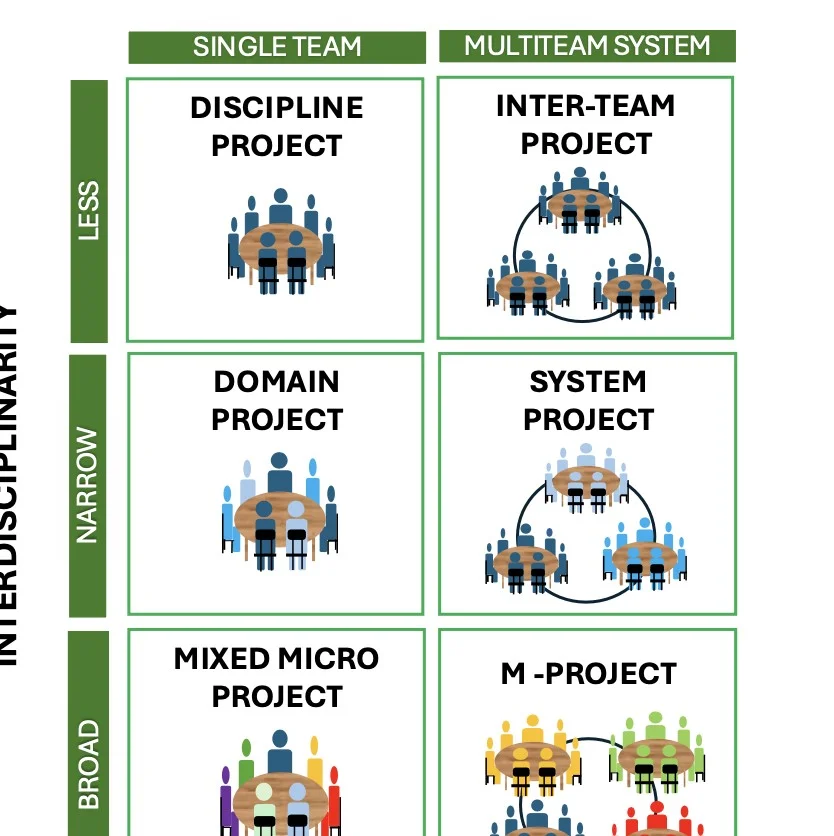
Aalborg’s InterPBL project started from a correction. The researchers found that earlier approaches to interdisciplinary projects were too simplistic because they treated interdisciplinary work as a single category. The project built a framework of six categories of disciplinary and interdisciplinary problem-based projects, defined along two dimensions: the type of knowledge involved, ranging from a single discipline to narrow and broad interdisciplinary problems, and the collaboration pattern, from a single student team to multi-team arrangements.
The distinction between narrow and broad interdisciplinarity carries weight. Greater distance between disciplines creates more difficulty in understanding scientific knowledge, along with cultural and pedagogical differences between the fields.
Aalborg’s central finding cuts against a common fear. Interdisciplinary collaboration does not mean an absence of disciplinary knowledge. The researchers report the reverse — students gain a better understanding of their own field (Routhe et al., 2023). What they also learn is where their expertise stops being useful to a collaborator.
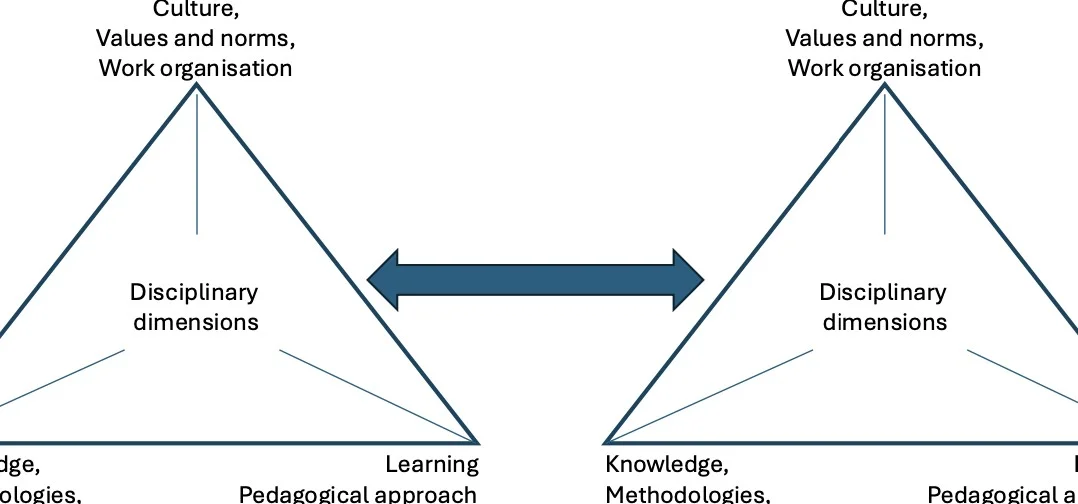
A second finding concerns scale. In multi-team system projects, project management tools were not enough. Students moved from applying project management tools to exercising leadership (Routhe et al., 2024), which required common visions, common knowledge bases and shared approaches to learning across teams. Three dimensions explained the variation in how students worked: knowledge, learning and culture.
Birmingham City’s contribution is the question of who is accountable. Shah lists the posts the university created to carry the STEAM agenda: a pro vice-chancellor for STEAM and interdisciplinary education, a director of interdisciplinary research and innovation, a director of innovative pedagogy, a STEAM integration lead in each faculty, a head of experiential and applied learning, and student STEAM champions.
The curriculum follows the same pattern. A collaborative project-based module sits at Level 4, with students building on it through Level 5 and Level 6 modules. The university runs micro-placements, student start-ups, joint lab sessions with businesses and live projects with public and private sector bodies, and hosts an annual Innovation Fest where student work is demonstrated. Shah argues explicitly that these priorities are about producing work-ready graduates through industry-informed teaching.
What The Chennai Merger Reveals About The Word Multidisciplinary
The three European cases become clearer against a non-European comparison sitting in the same source pool. SSN College of Engineering in Chennai applied for and received approval in September 2025 for a progressive closure from the 2026-27 academic year, as part of a phased merger into Shiv Nadar University Chennai. The stated aim, as reported by the Times of India, is to consolidate engineering education under one multidisciplinary university framework.
The measurable changes are in access and cost, not in curriculum design. Under the old route, seats were allocated through Tamil Nadu Engineering Admissions centralised counselling on Class 12 Physics, Chemistry and Mathematics marks, with no interview. Government quota tuition was ₹50,000 per year for non-accredited courses and ₹55,000 for accredited ones; management quota was ₹1,40,000 and ₹1,45,000 respectively. Under Shiv Nadar University Chennai’s published 2026-27 fee table, B.Tech tuition for Indian nationals is ₹3,50,000 per year for CSE, IT, ECE, EEE and AI and Data Science, and ₹3,00,000 for Mechanical, Civil, Chemical and Biomedical, before hostel and transport.
The contrast is the point. In Chennai, multidisciplinary is an institutional consolidation whose visible effects land on entry routes and fees. In Birmingham, Aalborg and the Semmelweis-John von Neumann partnership, it is a curriculum and governance construct whose effects land on timetables, credit splits and who holds the student record. When a ministry, regulator or vice-chancellor announces a push for training multidisciplinary engineers, the useful question is which of those two mechanisms is actually being proposed.
What To Watch
The published material contains no completion rates, no graduate employment data and no enrolment figures for any of the three programmes. Shah’s essay is an argument for a model, not an evaluation of it. Aalborg’s is a research framework. Semmelweis’s is a programme description. Any claim that these approaches improve employment outcomes for engineers remains untested in the sources cited here.
Watch three indicators. First, whether Aalborg’s six-category framework is adopted by institutions outside Denmark, which would show the narrow-versus-broad distinction travels. Second, whether the 66-34 medicine-to-engineering split at Semmelweis is replicated in other health-technology degrees, or stays a single case. Third, whether Birmingham’s named STEAM roles outlast the vice-chancellor who created them — the most common failure point for interdisciplinary reform.
Frequently Asked Questions
Which European universities are training multidisciplinary engineers?
Three documented examples are Birmingham City University, which runs a STEAM-based curriculum; Aalborg University in Denmark, whose InterPBL project produced a framework for interdisciplinary problem-based engineering projects; and Semmelweis University in Budapest, which runs a joint digital dental design bachelor’s degree with John von Neumann University of Kecskemét.
How is the Semmelweis digital dental design degree structured?
It runs six semesters and 180 credits, taught part-time with one week of face-to-face classes per month. Sixty-six per cent of teaching is medicine and healthcare delivered by Semmelweis, and 34 per cent is basic engineering delivered by John von Neumann University. A cooperation agreement makes Semmelweis responsible for aggregated student subject data and sets a common final examination and synchronised diploma thesis procedure.
Does interdisciplinary engineering education reduce disciplinary knowledge?
Aalborg University’s InterPBL researchers report the opposite. Their findings state that interdisciplinary collaboration allows students a better understanding of their own field, and that students gain rather than lose disciplinary knowledge. What students also learn is the limits and opportunities of collaborating across knowledge boundaries.
Receive alerts for training multidisciplinary engineers and more like it.
 Follow AFRILATEST on Google News
FIRST TIME REACTIONS:
Be the first to leave us a comment – 3 European Universities Training Multidisciplinary Engineers, down the comment section.
JOIN US ON OUR SOCIAL MEDIA:

About Rosabella Eboh
Rosabella Eboh is an author at AfriLatest. With a passion for writing and a flair for creativity, she contributes original content and unique perspectives to the platform. Rosabella focuses on human-interest stories, cultural trends, and in-depth feature reporting.
View all articles by Rosabella Eboh

JAMB & WAEC
JAMB O’Level Result Upload: What Home Verification Changes
JAMB O’Level result upload now runs from home for 2026 UTME candidates. What WAEC verification fixes, what it doesn’t, and how to prepare.

The JAMB O’Level result upload process for the 2026 Unified Tertiary Matriculation Examination no longer requires a trip to an accredited Computer-Based Test centre. Candidates can verify and upload West African Examinations Council results from home, and the Board checks those grades against the issuing examination body’s records before they land on a candidate’s profile.
The change is real, and it is narrow. It removes a queue, not a syllabus. The useful question is not whether home upload sounds modern. It is whether the shift improves learning access, outcomes, affordability or a candidate’s practical options — and on each of those four tests, the answer arrives with conditions attached.
What The JAMB O’Level Result Upload Actually Changes

The service was announced in a statement by the Board’s Acting Director, Public Affairs and Protocol, Dr Fabian Benjamin. Vanguard reported the Board’s framing: services made easier, faster, safer and more convenient, with electronic verification replacing a manual process that produced misplaced or mixed-up paper certificates and wrongly keyed subjects and grades.
The procedure is documented step by step. A candidate visits buyresultsverificationcode.ng, supplies a National Identification Number, selects the number of sittings and the examination body, adds an email address and GSM number, and pays through the gateway. Examination number, series and year follow. A Verification Code is issued. The candidate then sends “VERIFY” plus that code to 55019 or 66019.
Candidates with two sittings take a second route. Punch lays out the sequence: log into the e-Facility dashboard, select “2026 UTME O’Level Upload,” enter the Verification Code, choose between five and nine subjects with no subject selected twice, then click “Apply the O’Level Results.”
One limit deserves its own sentence. The service initially covers WAEC. Neither the Board’s statement nor the reporting confirms NECO or NABTEB. Candidates holding those results should treat coverage as unconfirmed until JAMB says otherwise, rather than assume a portal that accepted a friend’s WAEC slip will accept theirs.
Affordability, Cut-Offs And The Part The Portal Cannot Decide
On affordability, JAMB’s case is time and transport. Pulse reports the Board’s expectation that the system saves candidates transport costs and hours previously spent at crowded centres. That is plausible, and it is still conditional. The process requires a payment card or bank transfer, a phone that receives SMS, a working email address and a NIN. For a candidate in a city with a smartphone, those are trivial. For a candidate borrowing a relative’s line in a rural Local Government Area, they are the new bottleneck. Access has improved; it has not been equalised.
On outcomes, the arithmetic is unchanged. Admission turns on UTME score, O’Level grades, subject combination and institutional screening. A verified upload raises none of them. Cut-off marks are set by individual universities, polytechnics and colleges of education, department by department, and they move from year to year. Candidates should read the current brochure for their target institution instead of trusting a figure circulating in a WhatsApp group from last season.
The statements also leave two practical gaps. They do not describe what a candidate does when verification returns no record, or when the name on the examination body’s file does not match the NIN supplied — precisely the kind of mismatch an automated check is meant to catch. Nor do they state a completion deadline for the 2026 upload. Confirm both through JAMB’s official channels before payment day, not after.
Change Of Programme Online, And The Sentence JAMB Repeats
The same logic now covers course and institution changes. The Nigeria Education News reported the November announcement: candidates log into the e-Facility portal, open Corrections and Uploads, select Change of Programme/Institution, generate an invoice, pay, choose the new course or institution, and authenticate with a One-Time Password sent to the registered email.
JAMB attaches a warning to that convenience, and it is the most important line in the rollout: changing an institution or course does not guarantee admission. The candidate must still meet the UTME subject combination, O’Level requirements and screening conditions of the new choice. A portal that makes a change easier also makes a costly mistake easier. Print the confirmation slip. Check CAPS.
Active Recall, Timed Practice And Error Analysis For A Portal-Based Season
Saving an afternoon at a CBT centre does not save a term of study. Three methods carry the weight.
Active recall means closing the book, taking a blank sheet and writing everything remembered about a topic, then opening the text to find the gaps. Re-reading notes feels productive and is not. Retrieval is.
Timed practice means full papers under exam conditions: phone away, one sitting, strict clock. The UTME is computer-based and time-bound, and practice that ignores the clock trains the wrong skill.
Error analysis means a written log for every wrong answer with a cause attached — content gap, misread question, or time pressure. Re-test only the misses after 48 hours. A candidate who dissects 200 errors learns more than one who skims 2,000 correct answers.
Rules check before any of it. The syllabus is the contract. Confirm the current JAMB syllabus for each of the four subjects and the official brochure for the year before assuming a topic has been dropped or added.
The practical-options test is the one candidates can act on immediately. A saved trip is worth something only if it is spent on something: a library seat, a mock paper, a second sitting’s revision. The Board’s digital push is a logistics story. The admission story is still written in scores and grades.
Is The Home Verification Service The Right Fit
The JAMB O’Level result upload fits a candidate who holds a NIN, a phone line that receives SMS, a payment method and WAEC results — and who understands that the service removes a journey, not a requirement. It fits a school leaver far from an accredited centre who would otherwise pay a stranger to carry a certificate into a city. It fits less well the candidate holding NECO results, or the one who reads “no more CBT centre visits” as “no more work.”
The measured facts are procedural: the steps exist, they are documented, and four independent outlets carried the same sequence. The promise is that queues shrink and fraudulent submissions fall. The 2026 admission cycle will produce the evidence either way. Until then, the defensible reading is that JAMB has cut the cost of one administrative step and left the academic one exactly where it was.
Frequently Asked Questions
Can I upload my O’Level result on the JAMB portal without visiting a CBT centre?
Yes. For the 2026 UTME, JAMB introduced a system that lets candidates verify and upload O’Level results from home. Verification starts at buyresultsverificationcode.ng, where a candidate supplies a NIN, the number of sittings, the examination body, an email address and a GSM number, then pays and enters examination number, series and year. A Verification Code is issued, and the candidate sends “VERIFY” plus the code to 55019 or 66019.
Does the new JAMB system cover NECO and NABTEB results?
The announcements state that the service initially covers results issued by the West African Examinations Council. NECO and NABTEB coverage is not confirmed in the Board’s statement as reported. Candidates holding those results should confirm coverage through JAMB’s official channels before paying.
Does changing my course or institution on the JAMB portal guarantee admission?
No. JAMB states plainly that changing an institution or course does not guarantee admission. The candidate must still satisfy the UTME subject combination, O’Level qualifications and screening conditions of the new institution or programme, and should print the confirmation slip and check the CAPS profile afterwards.
FIRST TIME REACTIONS:
Be the first to leave us a comment – JAMB O’Level Result Upload: What Home Verification Changes, down the comment section.
JOIN US ON OUR SOCIAL MEDIA:
About Rosabella Eboh
Rosabella Eboh is an author at AfriLatest. With a passion for writing and a flair for creativity, she contributes original content and unique perspectives to the platform. Rosabella focuses on human-interest stories, cultural trends, and in-depth feature reporting.
View all articles by Rosabella EbohJAMB & WAEC
JAMB 2026: Verify Dates, Deadlines Before You Act
JAMB 2026 guidance built on verified notices: the mop-up date, admission deadline, disability refunds, and what to confirm before you act.

The useful question about JAMB 2026 is not whether the calendar looks busy. It is whether each announcement widens access to learning, improves outcomes, lowers what a family must pay, or leaves a candidate with more practical options than they had before. A press statement that fails all four tests is not guidance. It is noise.
The JAMB 2026 cycle has already produced four separate decisions: a mop-up examination date, a disability support package, an admission acceptance deadline, and a change to how O’Level results reach the board. Each answers a different question. Each carries a date a candidate can get wrong, and the published record shows that even the year label is not always stable.
Why The JAMB 2026 Record Needs A Year Check First
The disability support package is the clearest example. Punch reported the refunds and support provisions ahead of the Unified Tertiary Matriculation Examination without fixing a cycle in the headline. Peoples Gazette and Nigeria Info ran the same provisions under a 2027 UTME headline.
The provisions match across the reports: a refund of application document fees for candidates with disabilities who hold the required O’Level qualifications, audiobooks of prescribed texts for blind candidates, and covered transport and accommodation for blind candidates and their guides. Only the year moves.
That discrepancy is not academic. A candidate who reads the 2027 version and assumes the package begins in a later cycle may skip the single requirement that makes it work. The board’s wording, as quoted, is explicit: for the board to make necessary arrangements, a candidate must indicate disability status during registration.
Where reports disagree on the year, the board’s own channels outrank every aggregation. Confirm against the board’s official portal before acting on any JAMB 2026 notice.
What The 13 June Mop-Up Exam Can And Cannot Fix
Premium Times reports the mop-up for Saturday, 13 June 2026, following a main UTME held between 16 and 23 April 2026. Notification slips are printable from 6 June. Spokesperson Fabian Benjamin’s statement says the exercise covers candidates who were biometrically verified during the main examination but could not sit it for one reason or another, and warns that no candidate will sit the 2026 UTME after this exercise.
Read the JAMB 2026 mop-up as an access remedy, and a narrow one. It adds no syllabus content, no seats, and no movement on a cut-off point. It restores an attempt to candidates who already cleared verification.
The claim to watch is the board’s own: all affected candidates had been listed. That is a statement of intent, not evidence of contact. With more than two million candidates in the cycle, the figure that matters is how many listed candidates print a slip showing the correct centre. A candidate’s only reliable check is the slip itself, and it opens on 6 June.
Disability Refunds Test Affordability, Not Goodwill
The refund and the transport support are affordability measures, the kind that decide whether a qualified student turns up at all. Two constraints sit inside them. The refund is paid at the examination centre and, in the board’s words, only there. A candidate who cannot reach a centre collects nothing. And the admission consideration applies to candidates with disabilities who reach the minimum acceptable UTME score, so the support removes cost barriers without lowering the academic bar.
None of the reports reviewed gives a beneficiary count. A published figure for refunds actually paid at centres would be evidence. The announcement alone is not.
The 30 September Deadline That Decides Practical Options

Separately, BBC Pidgin reported that the board extended its admission acceptance deadline from 31 August to Wednesday, 30 September 2026. The window covers offers made between 2021 and 2026. Offers left untouched when the deadline passes flip automatically to a not-admitted status.
This is the cheapest decision in the JAMB 2026 cycle. It needs no examination, no fee, no travel, only an action taken in time. It is also the one most often lost, because an old offer from an earlier year feels inactive.
The same report describes a change to O’Level result handling: candidates verify and upload results from home instead of travelling to a CBT centre. The board’s stated aim is fewer manual entry errors and fewer unverified or fake results. That is an outcomes claim, and it can only be tested later, through admission records.
A Verification Routine For JAMB 2026 Candidates
Fix the year and the document first. Note the year printed inside the notice, not the year in the headline that led you to it.
Match the date to your own status. If you were verified but could not sit the main examination, the slip window opens 6 June and the mop-up is 13 June. If you hold an unaccepted offer from any year back to 2021, act before 30 September.
Confirm your disability declaration was made at registration. On the board’s wording, the arrangements depend on it, and it cannot be added after the fact.
Test the promise against your own record. The board says affected candidates were listed; the slip proves it.
Note what the reviewed reports do not contain. There is no 2026 syllabus document, no fee schedule, and no cut-off announcement in this material. The Premium Times report notes that cut-off points are determined by universities. Anyone presenting a 2026 cut-off as settled board policy without an official policy meeting notice should be treated with caution.
Start With One Date
The discipline that makes JAMB 2026 usable is simple: take one date at a time, confirm it on the board’s own channel, and act before the window closes. Begin with the nearest deadline that applies to you, whether that is the 6 June slip printing for listed mop-up candidates, the 13 June examination itself, or the 30 September offer deadline. Then read the year on the notice a second time. Most candidates who lose opportunities this cycle will not be the ones who scored low. They will be the ones who acted on a headline instead of a document.
Start with the slip. Print it, check the centre on it, and check the year on it. Everything else follows from that.
Frequently Asked Questions
When is the JAMB 2026 mop-up examination?
Saturday, 13 June 2026. It follows a main UTME held between 16 and 23 April 2026, and examination notification slips are printable from 6 June. The board states that no candidate will sit the 2026 UTME after this mop-up.
Is the disability fee refund for the 2026 or 2027 UTME?
Published reports conflict. Punch described the provisions ahead of the UTME without fixing a cycle, while Peoples Gazette and Nigeria Info ran them under a 2027 UTME headline. The provisions themselves are identical in all three. Candidates should confirm the applicable year on the board’s official channels before acting.
What happens if I do not accept my admission offer by 30 September 2026?
According to the BBC Pidgin report of the board’s statement, offers made between 2021 and 2026 that stay unaccepted or unrejected when the deadline passes automatically change to a not-admitted status on the board’s records.
Do the reviewed reports contain a 2026 cut-off point?
No. The reviewed material contains no cut-off announcement for the cycle, and the Premium Times report notes that cut-off points are determined by universities. Confirm any cut-off through official policy meeting notices rather than third-party summaries.
FIRST TIME REACTIONS:
Be the first to leave us a comment – JAMB 2026: Verify Dates, Deadlines Before You Act, down the comment section.
JOIN US ON OUR SOCIAL MEDIA:
About Rosabella Eboh
Rosabella Eboh is an author at AfriLatest. With a passion for writing and a flair for creativity, she contributes original content and unique perspectives to the platform. Rosabella focuses on human-interest stories, cultural trends, and in-depth feature reporting.
View all articles by Rosabella EbohStudy & Education
The Downstairs Gentry: Why Academics Defend Their Own Demotion
The downstairs gentry explains why lecturers defend universities that treat them as staff, and what that means for Nigerian campuses.

A lecturer in a Nigerian public university will defend that institution’s reputation at a conference, on radio, in an argument with a stranger — then return to a department where the decisions that shape his working life were taken in a room he was not invited into. A new opinion essay in Inside Higher Ed gives that contradiction a floor plan, borrowed from Downton Abbey. Its central figure is the downstairs gentry: the academic middle tier that carries prestige without power, and defends the house anyway.
The essay sets the Edwardian country house against the modern university. Upstairs live the Crawleys, the landed aristocrats who hold title and embody the estate’s glory. Downstairs, reached through narrow hidden staircases, works an invisible army keeping the chandeliers lit, the fires stoked and the silver polished. Translated to the campus, upstairs is central administration, senior leadership and the board of trustees, whose stated concerns are legacy, estate preservation and brand equity. Downstairs is academic labour: tenured professors, tenure-track hopefuls, clinical instructors, adjunct lecturers and support staff.
Nigerian readers will recognise the architecture even without the English furniture. The governing council and the vice-chancellor’s office occupy the upstairs of the metaphor; the lecturing corps, graduate assistants, adjuncts, technicians and cleaners occupy the downstairs. The essay concedes its parallel is imperfect, and the concession is worth repeating: many academics sit in between, privileged relative to contingent teachers and staff, yet subordinate to senior administrators, boards and donors. That in-between group is what makes the downstairs gentry worth naming.

One caveat before the argument goes further. This is an opinion essay in a views section, not a survey. It presents no original data and no sample of institutions; its evidence is analogy, anecdote and the sociology it borrows. The Downton framing should be read as an argument to be tested against what readers see on their own campuses, not as a measured finding.
Why The Downstairs Gentry Defends A House It Does Not Own
The essay’s sharpest mechanism is what it calls stratified solidarity. Tenured and tenure-track faculty are encouraged to identify upward, partly because they are positioned closer to the gentry than to the adjuncts and professional staff on whose labour the institution increasingly depends. The reward on offer is not power but proximity.
The author reaches for Pierre Bourdieu’s description of intellectuals as the dominated fraction of the dominant class: high in status and low in power at the same time, rich in the currency of prestige and poor in the currency that decides outcomes. Borrowed prestige, the essay argues, is a poor substitute for real influence in governance — and a substitute that gets harder to maintain as structures for shared governance erode.
There is a telling detail about silence. A member of an accreditation committee, the author reports, struggled to understand why faculty members never voiced criticisms of their employer when invited to speak openly and assured of full confidentiality. The essay’s answer is that the division is experienced not as domination but as belonging, and that the risk of speaking is tangible: an unfavourable evaluation, a tenure case that looks less certain, a reputation for disloyalty that thwarts mobility.

What Nigerian Campus Politics Shares With Downton Abbey
Universities speak of community and shared governance. The essay argues the distribution of power, security and voice is organised on the upstairs/downstairs principle. Department meetings include everyone in principle, but the real decisions happen in closed-door sessions where only certain voices are heard. Faculty senates are informed of decisions that were once subject to a vote.
The same pattern of uncredited maintenance shows up well outside the campus. Reporting by The Art Newspaper on the artists of New York’s Hotel Chelsea describes relatives who stayed in the building for decades to preserve work the market had ignored: Sybao Cheng-Wilson keeping her brother Ching Ho Cheng’s apartment and art after his death, Judith Childs still living among Bernard Childs’s canvases, Mary Anne Rose overseeing Herbert Gentry’s estate. Recognition, when it came, arrived late and largely through family labour. The lesson travels. The people who hold an institution’s memory together are rarely the people the institution credits.
The Postwar Moment, And Who Pays For The Roof
Downton Abbey’s plot turns on an existential threat: the post-First World War collapse of the landed-estate model, as rising taxes, changing labour markets and social democratisation forced the nobility to sell off land, lay off staff and open their halls to paying visitors. The delusion of the eternal great house was shattered.
The essay argues higher education is having its own postwar moment. The aristocratic bargain — years of servant-like grind in the doctoral trenches in exchange for a seat at the main table — is described as effectively dead. Yet leadership, like Lord Grantham refusing to sell the art collection while the roof leaks, keeps planning new campuses and adding executive positions while the academic core is starved. Ageing tenured faculty, cast as the butler Mr Carson, lament the loss of collegiality without recognising that the material conditions which produced it were deliberately dismantled.
Programme closures and staffing cuts, the essay notes, are routinely justified as necessary responses to enrolment declines and budget shortfalls even as new administrative units and capital projects proceed. The author’s reading is that these are not isolated incidents but recurring features of a governance model in which crisis legitimises centralisation. Nigerian campuses, long familiar with retrenchment and with decisions announced rather than negotiated, are not outside that pattern.

The Big Picture
The essay’s conclusion is blunt and deliberately unbecoming: we are not the gentry, we are the staff. That is a strange position to occupy — devoted to a place’s reputation at precisely the moment it has made clear how little the devotion buys.
The answer it offers is not to stop caring about the institution, but to stop confusing care for it with consent to its governance. For the downstairs gentry, in Abuja, Ibadan, Nsukka or anywhere else, that distinction is the whole argument. Loyalty that is never converted into voice does not protect the house. It pays for the repairs while somebody else decides which rooms stay open.
Frequently Asked Questions
What does the downstairs gentry mean?
It describes the academic middle tier — tenured and tenure-track staff, clinical instructors and senior support workers who hold institutional prestige but little decision-making power, and who nonetheless identify with the leadership above them rather than with the contingent staff beside them.
Is the Downton Abbey comparison based on a study?
No. It appears in an opinion essay published by Inside Higher Ed, which uses analogy, anecdote and borrowed sociology rather than survey data. It should be treated as an argument, not a measured finding.
Why does this matter to Nigerian readers?
The governance pattern the essay describes — decisions taken above the lecturing corps, crisis used to justify centralisation, loyalty rewarded with proximity rather than voice — maps onto familiar tensions between Nigerian university administrations, governing councils and academic staff.
FIRST TIME REACTIONS:
Be the first to leave us a comment – The Downstairs Gentry: Why Academics Defend Their Own Demotion, down the comment section.
JOIN US ON OUR SOCIAL MEDIA:
About Rosabella Eboh
Rosabella Eboh is an author at AfriLatest. With a passion for writing and a flair for creativity, she contributes original content and unique perspectives to the platform. Rosabella focuses on human-interest stories, cultural trends, and in-depth feature reporting.
View all articles by Rosabella Eboh-

 Car Reviews2 weeks ago
1955 Chevy Bel Air Restomod: What SEMA Really Proves
-
Savings & Investing4 weeks ago
Hidden Medicare Fees Draining Your Retirement Savings
-
JAMB & WAEC4 weeks ago
JAMB Admission Process: What Changed And What Is Still Talk
-
World News4 weeks ago
Sheinbaum No Proof Maduro: Mexico’s Test of US Evidence
-
Movies & TV4 weeks ago
Wizkid Starboy Desire Ft Banky W Shaydee: Fact Or Fan Fiction?
-
Trend politics4 weeks ago
How 24-Hour Online Scrutiny Is Running Out Leaders