Black Celebrities
Jane Levy Evil Dead Return: A Tease, Not a Deal Yet
Jane Levy Evil Dead return talk is a Q&A tease, not a confirmed deal. What the verified record shows about Mia Allen, Sam Raimi and Evil Dead Wrath.


Jane Levy did not announce a comeback. She asked a room a question.
That is the whole of the verified record. At a post-screening Q&A for the 2013 Evil Dead reboot, hosted by Contra Celluloid, the actor took the microphone and put it to the audience: “I have a question. Do you guys think Mia should come back to Evil Dead?” The room applauded. “OK cool, I was just checking. That’s all,” she said.
She then joked about calling the franchise’s original architect directly: “Let’s call Sam’s Skype number right now and see if he wants Mia to come back.”
No casting notice followed. No studio statement. Neither Deadline, which reported the clip, nor any other outlet has confirmed a deal, a contract, or a start date. For fans, that gap is the story.
What the Q&A Actually Confirmed
Two things, and neither is a role. Levy confirmed she is willing to be publicly attached to the question, and she confirmed that an audience still cheers for Mia Allen, the recovering addict who survives Fede Alvarez’s reboot and ends it with a chainsaw.
Dread Central’s account is blunt about the limits. “It doesn’t sound like that last part happened. Nor is this Levy affirming she’ll be back for Wrath. She also easily could’ve said she isn’t involved. But she didn’t.”
That last observation carried most of the online excitement, and it is worth naming plainly: it is an absence, not a statement. An absence is not evidence of a deal.
Why the Jane Levy Evil Dead Return Talk Is Not a Deal
Franchise decisions get confirmed in public, in one of two ways: a studio announcement, or a direct statement from the person involved. Bruce Campbell’s exit from Ash is the model. He told the Detroit Free Press he was finished with the role after his cancer diagnosis, and said the series had “moved away from Sam Raimi” and “moved away from Ash and Bruce Campbell.”
That is a documented position, on the record, from the actor who holds it. Levy’s is a joke about Skype, delivered to a paying audience at a revival screening.
Precedent matters too. The 2013 film was built with an open door, a post-credits implication that Mia might one day cross paths with Ash, and the door stayed shut for more than a decade while the franchise made other films.
Cross-linking is a franchise habit rather than a rumour. Campbell cameoed as Ash in that 2013 reboot, then led Ash vs Evil Dead on Starz from 2015 to 2018, tying the reboot era back to the original trilogy. That habit is precisely why one Q&A line travels so far.
The Slate Is Booked Through 2028
The series has not been waiting on her. Lee Cronin’s Evil Dead Rise arrived in 2023. Sebastien Vanicek’s Evil Dead Burn followed this year and, per Dread Central, closed with a post-credits reveal pointing to a widening shared universe.
Next is Evil Dead Wrath, directed by Francis Galluppi and dated for April 7, 2028. Producer Robert Tapert calls it “another great departure,” which is fair: it is a prequel to the original 1981 film, set in 1972.
None of those three films is a confirmed Jane Levy Evil Dead return. And the 1972 setting is a structural fact fans should hold onto. A period prequel has no obvious slot for a character introduced in 2013 unless the film uses a framing device nobody has announced. Nothing in the public record confirms one.
What Would Make This Real
Three signals, in ascending order of strength. A trade report carrying deal terms. A casting announcement naming Levy from the production side. Or Levy herself confirming it in an interview, rather than in an audience Q&A.
Until one of those lands, the accurate description is unconfirmed. Levy has her own slate on the record, the backwoods slasher River and a small role in Whalefall, and her private reasons for wanting or not wanting to revisit Mia have not been made public. They are not owed to anyone.
Where the Real Business Story Sits
Oddly, the clearer business story in this franchise right now belongs to Campbell, not Levy. Campbell announced in March that he had been diagnosed with a “treatable” but not “curable” form of cancer, and he has spent the year on a self-financed film, Ernie & Emma, which he wrote, directed and stars in.
He and his wife, Ida Gearon, put up the money themselves and shot it in Oregon, where a state incentive program returns 20% of production costs, he told the Detroit News. The film has toured grassroots-style to venues including Detroit’s Redford Theatre. He has described it to OPB as a way out of being typecast as the “Evil Dead guy.”
That is what a confirmed career move looks like: money committed, locations booked, dates announced, a star doing press. Compare it with a clip of applause.
Will It Succeed?
As franchise maintenance, the tease already works. It cost nothing, it travelled across film sites and social feeds, and it kept Levy’s name tied to a series she last appeared in more than a decade ago.
As a casting event, it has not happened. The evidence shows an actor testing appetite, an audience answering loudly, and no public statement from Sam Raimi on a Mia return anywhere in the reporting around the Q&A. A Jane Levy Evil Dead return remains a possibility the franchise has left open, not a deal it has signed.
Frequently Asked Questions (Jane Levy Evil Dead return)
Has Jane Levy confirmed she is returning to Evil Dead?
No. She asked an audience at a Q&A whether Mia should come back, and joked about calling Sam Raimi’s Skype number. No studio, producer or trade report has confirmed a deal, and Levy has not stated she is cast in Evil Dead Wrath or any future film.
Is Mia Allen in Evil Dead Wrath?
There is no public confirmation either way. Evil Dead Wrath is a prequel to the 1981 original, set in 1972 and dated for April 7, 2028. Nothing in the reporting establishes a role for Mia, and the period setting makes one structurally awkward without an announced framing device.
Why did this moment get so much attention?
Because Levy did not rule anything out. Dread Central noted she could easily have said she was not involved and did not. Combined with a post-credits reveal in Evil Dead Burn hinting at a wider universe, an unanswered question was enough to drive speculation.
 Follow AFRILATEST on Google News
FIRST TIME REACTIONS:
Be the first to leave us a comment – Jane Levy Evil Dead Return: A Tease, Not a Deal Yet, down the comment section.
JOIN US ON OUR SOCIAL MEDIA:

About Rose Green
Rose Green is an entertainment and lifestyle author at AfriLatest. With a passion for storytelling, she contributes creative and thought-provoking content, capturing the imagination of readers. Rose specializes in entertainment news, celebrity updates, and lifestyle trends, sparking meaningful conversations across diverse topics.
View all articles by Rose Green

Black Celebrities
Star Wars Villain Theory: What Kade Auberon Evidence Shows
The Star Wars villain theory around Ryan Gosling’s Kade Auberon is unverified. Here is what Levy, Gosling and the Legends canon actually confirm.

Star Wars’ Kade Auberon Problem Is Bigger Than One Villain Theory
Star Wars has a new character name to argue about and very little confirmed story to attach to it. At Disney’s D23 Entertainment Showcase, director Shawn Levy confirmed that Ryan Gosling plays a character called Kade Auberon in Star Wars: Starfighter. The name alone has since powered a Star Wars villain theory that neither Levy nor Lucasfilm has endorsed.
The dispute is narrow, and that is the point. Fans are not arguing over a leaked script or a spliced trailer frame. They are arguing over whether a first name is evidence.
The Star Wars Villain Theory Fans Built From One Name
On X, users responded to the D23 reveal by connecting “Kade” to Cade Skywalker, a character introduced in the Star Wars: Legacy comic series more than two decades ago. One user wrote: “Calling it now. He’s [Cade] Skywalker.” Another posted: “Blonde cynical rogue named Kade with a mysterious past set long after Episode VI? Welcome back Cade Skywalker.”
That is close to the whole evidentiary base. According to Yahoo Entertainment, the Legends version of Cade was a bounty hunter and ex-Jedi padawan, a direct descendant of Luke Skywalker and Mara Jade, and a figure believed to hold the power to resurrect the dead.
Match the archetype to a two-word casting announcement and the theory assembles itself. It has not been confirmed by anyone who would know.
What Levy And Gosling Actually Confirmed At D23
The confirmed record is thinner than the speculation. Levy named the character. Gosling described him as “a guy from the wrong side of the galaxy whose fate is intertwined with the fastest starfighter ever built.”
Nothing in that sentence establishes a villain. Nothing establishes a Skywalker bloodline. Nothing establishes that Kade Auberon is Cade Skywalker under a different spelling. Gosling and Levy were also at the event to discuss a separate Ghost Rider project, which tells you how early in the rollout this film still sits.
Starfighter has been presented as a standalone story, and reported as such. The film’s cast includes Matt Smith, Mia Goth, Aaron Pierre, Amy Adams and Flynn Gray. Levy has said he was particularly inspired by Return of the Jedi. The release date is May 28, 2027, and the reporting does not detail regional rollout plans beyond that.
There is a real precedent keeping the theory alive. Grand Admiral Thrawn moved from Legends into canon through Rebels and later Ahsoka, played again by Lars Mikkelsen. Re-canonisation happens. It simply has not happened here, and no announcement suggests it will.
Why The Ripped-Off Feeling Cuts Both Ways
The “ripping off” framing gets stranger when you look at the films around Star Wars rather than inside it. A review of Predator: Badlands published by WBOC catalogues the Star Wars beats it says director Dan Trachtenberg borrowed: plasma swords that read as lightsabers, a father-son fight that ends with an arm severed, a robot that loses its legs and must be carried on another character’s back, and a warrior protecting an alien child.
That is one critic’s reading, not a legal finding, and reviewers routinely map franchise grammar onto new films. But it is a more specific claim than the Kade theory, because it points at scenes an audience can actually watch.
The pattern extends further. The Direct reports that a former Cartoon Network animator has claimed Pixar copied one of his creations for a character in Toy Story 5, the sequel that adds Bad Bunny to a cast already featuring Greta Lee as the villain Lilypad and opens on June 19. The reporting does not detail a studio response to that claim.
So the industry conversation fans are having is not really about one name. It is about how quickly a franchise audience now reads borrowing into everything, including a film that has released a title card and a character name.
Where The Star Wars Villain Question Stands
The verified position is simple to state. Kade Auberon is confirmed. Cade Skywalker is a Legends character who exists in old comics. The bridge between them is fan inference built on four letters and a familiar silhouette, and it collapses the moment someone asks for a second source.
That does not make the theory stupid. It makes it unproven, which is a different thing, and the difference matters for a film nearly a year and a half from release. Fans who repeat the Star Wars villain rumour as settled fact are doing what the Thrawn precedent invites and what the actual reporting does not support.
Until Lucasfilm, Levy or Gosling says otherwise, treat Kade as a name and nothing more. The 2027 release will settle it. Until then, the loudest claim in the room is still the one with the least evidence behind it.
Frequently Asked Questions (Star Wars villain)
Who is Kade Auberon in Star Wars: Starfighter?
Kade Auberon is the character name Ryan Gosling plays in Star Wars: Starfighter, confirmed by director Shawn Levy at Disney’s D23 Entertainment Showcase. Gosling described him as a man from the wrong side of the galaxy whose fate is tied to the fastest starfighter ever built. No further backstory has been confirmed.
Is Kade Auberon actually Cade Skywalker?
That is unconfirmed fan speculation. Cade Skywalker is a Legends character from the Star Wars: Legacy comics, a descendant of Luke Skywalker and Mara Jade. The theory rests on a similar name and archetype, not on any statement from Lucasfilm, Levy or Gosling.
When does Star Wars: Starfighter come out?
The film is scheduled for release on May 28, 2027. It is directed by Shawn Levy and stars Ryan Gosling alongside Matt Smith, Mia Goth, Aaron Pierre, Amy Adams and Flynn Gray.
FIRST TIME REACTIONS:
Be the first to leave us a comment – Star Wars Villain Theory: What Kade Auberon Evidence Shows, down the comment section.
JOIN US ON OUR SOCIAL MEDIA:
About Rose Green
Rose Green is an entertainment and lifestyle author at AfriLatest. With a passion for storytelling, she contributes creative and thought-provoking content, capturing the imagination of readers. Rose specializes in entertainment news, celebrity updates, and lifestyle trends, sparking meaningful conversations across diverse topics.
View all articles by Rose GreenBlack Celebrities
Budget Swimwear Lessons From Sahara Ray Swim
Sahara Ray’s death at 34 puts her label Sahara Ray Swim in focus. What budget swimwear shoppers should take from its commercial context.


The budget swimwear goal is straightforward: a drawer of pieces that look deliberate without a designer receipt. The death of Sahara Ray at 34, confirmed by her family to TMZ, gives that goal an unexpected frame. Ray was not only the Australian model photographed vacationing in Hawaii with Justin Bieber in 2016. She founded Sahara Ray Swim, a label built on the Instagram following that made her name.
That combination — a face, a following, a small swim line — is the template for an entire tier of independent labels. Understanding how that tier works is the difference between buying budget swimwear that lasts and buying a photograph.
What Sahara Ray Swim Actually Was
Confirmed facts about the label are limited. Ray launched Sahara Ray Swim and sold it through her social presence, per TMZ. She was the daughter of Australian surfer Tony Ray and spent much of her childhood moving between Australia, California and Hawaii. That coastal triangle is commercial context rather than a design brief: swim brands born from surf cultures sell lifestyle first and construction second.
The record contains no verified information on fabrics, manufacturing partners, factory locations or retail pricing for Sahara Ray Swim. Any specific claim about its sourcing would be invention. That silence is common among founder-led swim lines, which frequently launch on short production runs and disclose little.
The Hard Economics Of A One-Name Label
Swim is an unforgiving category. Fit is technical, sizing varies between brands, and the selling window is narrow. A label fused to one person carries extra exposure, because the founder and the brand are the same asset.
Elastane is the reason so much of the resale market disappoints. Chlorine, heat, sunscreen and sunlight break down stretch fibres, and a garment that looks intact can be structurally finished. For budget swimwear shoppers, this is the single most useful thing to know: condition beats label every time.
Budget Swimwear Styling That Survives A Season
Start with solids. A black, chocolate or navy one-piece outlives prints, which date faster and photograph worse. Square necks, high legs and tie sides are silhouettes, not logos, and every high-street tier reproduces them each season.
Test recovery before you buy, in a shop or at a thrift stall. Stretch a strap or the leg opening and release it. If it does not snap back, the stretch fibre is spent and no amount of styling will save it. Check the gusset stitching, look for full lining, and reject anything with chalky or faded elastic.
Thrifted swim needs a wash and a repair, not a rewrite. Shortening a strap, taking in a side seam on a one-piece, or replacing a tired tie is a cheap alteration and the fastest route to a fit that feels made for you. A tailor who handles dancewear or lingerie will understand the stretch seams; a general alterations shop may not.
For high-street dupes, match geometry rather than branding. Photograph the shape you want, then compare seam placement, cup construction and rise. A dupe that gets the cut right and the fabric wrong will fail by August. One that gets the cut right in a denser knit will hold.
What The Court Record Says, And What It Does Not
Chloe Spence, a former roommate, filed for a restraining order against Ray in June 2024, according to court documents obtained by TMZ. Spence alleged Ray was taking Xanax without a prescription and had been in an “intoxicated delusional state” on more than one occasion, and alleged an April 2024 incident turned physical. The request was dismissed in July 2024 after neither party appeared for a hearing.
Sources close to the situation told TMZ the two resolved their differences, and Spence was by Ray’s side when she died. Ray’s cause of death has not been confirmed, and there is no established connection between the 2024 allegations and her death.
Separately, Ray spoke publicly in 2024 about Guillain-Barré syndrome, a rare neurological disorder that left her partially paralysed following a serious car accident. Her daughter, Snow, was born earlier this year.
Why The Label Story Matters After The Person
Founder-led labels rarely survive their founder intact. The design language, the customer list and the credibility usually sit with one person, which is why many small swim brands quietly close rather than change hands. That is a commercial fact, not a tribute.
It also shapes what shoppers should expect. Names built on a single face tend to produce in small runs, restock unpredictably and hold resale value unevenly. Buying budget swimwear from that tier works when you buy the garment rather than the association.
The Best Budget Hack
The most reliable budget swimwear move is to buy the silhouette and ignore the label entirely. Pick the shape, test the stretch, budget for one alteration, and put the saved money into a second solid colour instead of a print. Two well-fitted, well-chosen pieces outperform six that photograph once.
Sahara Ray built a label on an image and died at 34. The garments remain a separate question from the person, and readers are better served judging them on seams, stretch and cut. That is the honest version of budget swimwear advice, and it is the only version the available record supports.
Frequently Asked Questions
Did Sahara Ray design her own swimwear label?
Yes. TMZ reports that Ray launched Sahara Ray Swim and built it on her Instagram following. The available record does not disclose her fabrics, manufacturers, factory locations or pricing, so any claim about how the pieces were produced would be speculation.
What should I check before buying second-hand swimwear?
Test the stretch first. Pull a strap or leg opening and release it; if it does not spring back, the elastane is degraded and the garment will fail. Then check the gusset stitching, confirm there is a full lining, and reject faded or chalky elastic.
What is the cheapest way to copy a designer swim silhouette?
Match the geometry, not the logo. Photograph the cut you want, then compare seam placement, cup construction and rise on high-street versions. Build in the cost of one small alteration, such as shortening a strap, and spend the difference on a second solid colour rather than a print.
Receive alerts for budget swimwear and more like it.
FIRST TIME REACTIONS:
Be the first to leave us a comment – Budget Swimwear Lessons From Sahara Ray Swim, down the comment section.
JOIN US ON OUR SOCIAL MEDIA:

            About Paul Nwogo
            Paul Nwogo is an engineer, published author, and the Head Manager at AfriLatest. He has written numerous books available on Amazon covering a diverse range of topics, including health, personal finance, relationships, work ethics, and scam survival. With his technical background and passion for writing, Paul now oversees the editorial direction of AfriLatest, delivering practical, accurate, and engaging content on trending news, music, and global lifestyle topics.
            View all articles by Paul Nwogo

Black Celebrities
Shanghai Fashion Week: A Fifth Fashion Capital Rises
Shanghai Fashion Week is building an ecosystem for designers. Could it become a fifth fashion capital? We analyse the craft, business, and talent.
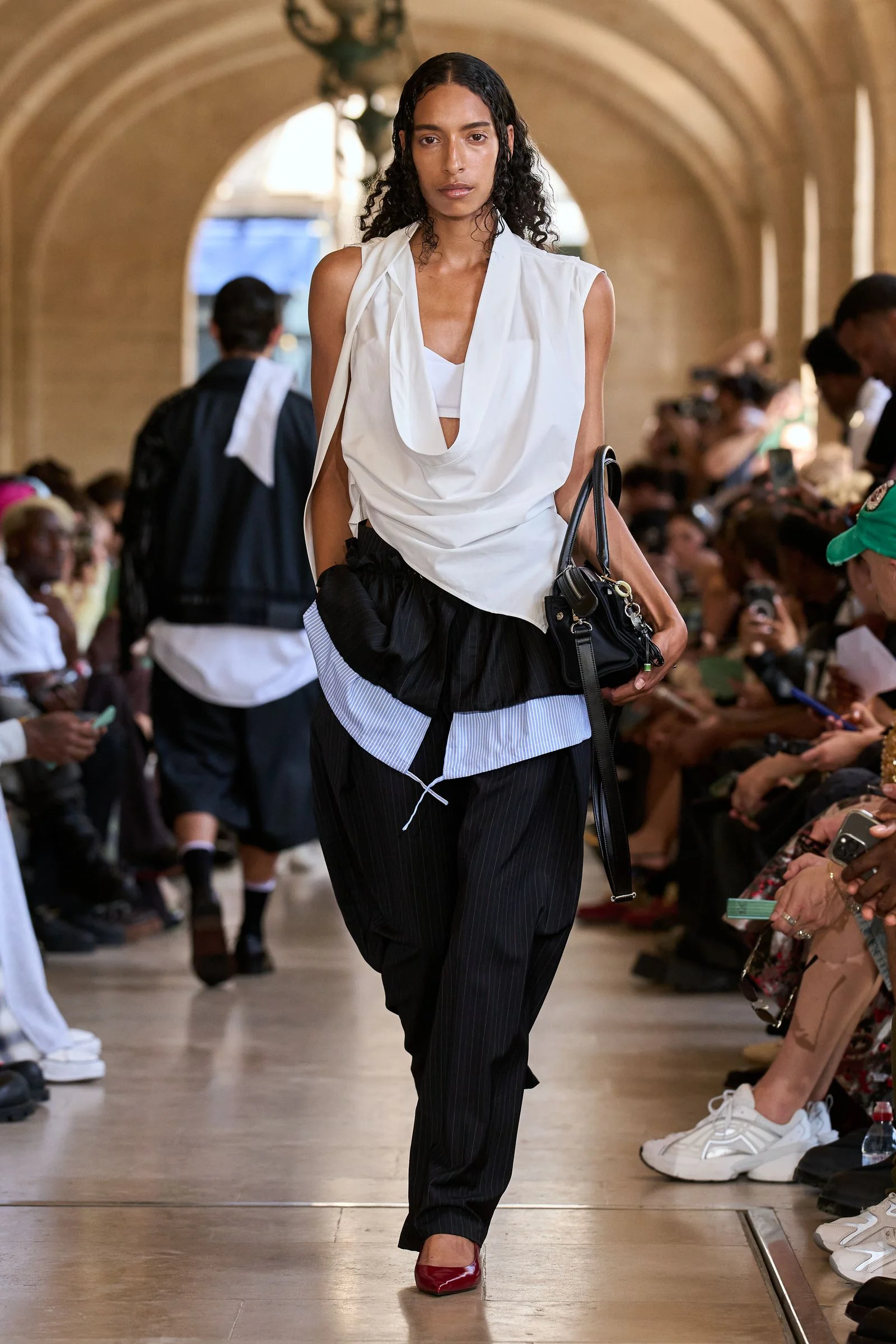
Shanghai Fashion Week has spent a decade building something that looks less like a copy of the big four and more like its own machine. Since 2015, the event has developed an ecosystem that brings together presentations, showrooms, and business opportunities, explained Landon Du, SWF Projects Director. The ambition is clear: to position Shanghai as a fifth fashion capital, not just a regional stop on the circuit.
The main venue generally requires designers to have at least two years of experience, with applications assessed by a committee comprising industry professionals, media, showroom owners, and buyers. Labelhood, by contrast, offers a more open platform for emerging names. That two-tier system matters. It gives young labels a runway without forcing them into a commercial pressure cooker too soon, while established names get a more curated showcase.
Showing a collection is hardly an inexpensive exercise. Production, models, styling, lighting, and public relations all have to be paid for, and sponsorship rarely covers the entire bill. Many of the designers on the calendar have therefore already established retail businesses in China, with some reaching multibrand stores internationally. The business infrastructure supports creative independence. Liu pointed to China’s production capabilities and developed e-commerce channels as advantages that allow young labels to reach consumers without first having to build an elaborate international distribution network. Designers can grow through online sales and multibrand retail before opening their own stores. In other markets, that journey can be considerably more arduous.

Craft Is The Calling Card
The commercial awareness does not mean the clothes are merely an exercise in consumer appeasement. One of the most compelling developments, according to both Liu and Du, is the growing engagement with Chinese heritage, craftsmanship, and traditional techniques. Designers are looking beyond familiar cultural references to explore processes preserved by families and communities, including traditional dyeing and embroidery. The challenge is to bring these practices into the present without turning them into museum pieces.
Liu cited Kinyan Lam, which works with traditional dyeing techniques from rural areas in southwestern China, and Samuel Gui Yang, whose work approaches Chinese aesthetics with a contemporary sensibility. For Abbie, the appeal lies in the way craftsmanship is integrated into clothes that can actually be worn. He spoke of designers devoting months to intricate embroidery, sometimes at a level comparable to couture, while creating pieces intended for everyday life. The distinction matters: these are not necessarily precious objects designed to be admired from a safe distance, but expressions of craft that remain accessible to younger customers.
That balance between heritage and wearability is where Shanghai’s designers are making their mark. It is not about reproducing historical costume. It is about translating technique into garments that fit into a modern wardrobe, whether that means a hand-dyed jacket or an embroidered shirt that works with jeans. For Nigerian designers and consumers watching from Lagos or Abuja, the parallel is worth noting. The same conversation is happening around aso-oke, adire, and hand-woven textiles: how to honour the craft without pricing out the people who grew up with it.
A New Generation Goes Global
The international reach is expanding. A new generation of Chinese fashion designers are extending their international footprints beyond western markets, tapping sourcing hubs in India and Turkey and retailers from Dubai to Mexico, according to Business of Fashion. That shift matters for African markets too. Dubai and Mexico are closer to Lagos than Paris in terms of distribution and consumer patterns, and the sourcing hubs in India and Turkey are already part of many African designers’ supply chains.
But the picture is not uniformly rosy. The same report noted that the Shanghai shows can be formulaic and unoriginal, though China’s fashion capital is producing a handful of talents with the potential to go global. That is a fair assessment of any fashion week, including the big four. The difference is that Shanghai is still in its honeymoon period with the global industry, as Business of Fashion put it years ago. The city’s fashion leaders seem happy to experiment at every juncture and supremely unfazed when things go a bit wrong.
That experimental energy has attracted international brands. At one edition, international brands made up 58 percent of the 1,000-plus brands exhibiting across the four official trade shows. Entire delegations flew in from South Korea, Taiwan, Hong Kong, and Japan. From further afield, Italians, Turks, Brits, French, Australians, Americans, and Scandinavians all descended on fashion week to boost business in the all-important Chinese mainland. The sales floors have become so international that overseas brands outnumbered those from mainland China.
Will The Trend Trickle Down?
The question for readers in Nigeria and elsewhere is whether Shanghai’s model offers lessons. The first is infrastructure. Shanghai Fashion Week’s committee system, with buyers and showroom owners assessing applications, creates a filter that protects both designers and retailers. The second is e-commerce. China’s developed online sales channels allow young labels to reach consumers without building a physical retail network first. That is a reality Nigerian designers know well, with Instagram and WhatsApp serving as primary storefronts.
The third is craft. The emphasis on traditional dyeing and embroidery, not as a marketing hook but as a design foundation, is a direct challenge to the idea that African textiles are only for special occasions. Designers like Kinyan Lam and Samuel Gui Yang are showing that heritage techniques can be part of everyday clothes. The same could be said for adire shirts or aso-oke jackets designed for daily wear, not just weddings.
Shanghai Fashion Week still has much to prove. It may lack the rigour of Tokyo and the pizzazz of Seoul, but it overshadows them both in terms of chutzpah. Whether it becomes a true fifth fashion capital depends on whether its designers can turn craft into a sustainable business. For now, the ecosystem is in place. The next step is proving that the clothes can travel as far as the ambition.
Frequently Asked Questions
What makes Shanghai Fashion Week different from other fashion weeks?
Shanghai Fashion Week has developed an ecosystem that brings together presentations, showrooms, and business opportunities since 2015. It uses a committee to assess applications for its main venue, requiring at least two years of experience, while Labelhood offers a more open platform for emerging names.
Which designers are known for traditional Chinese craftsmanship at Shanghai Fashion Week?
Kinyan Lam works with traditional dyeing techniques from rural areas in southwestern China. Samuel Gui Yang approaches Chinese aesthetics with a contemporary sensibility.
How does Shanghai Fashion Week support young designers?
China’s production capabilities and developed e-commerce channels allow young labels to reach consumers without first building an elaborate international distribution network. Designers can grow through online sales and multibrand retail before opening their own stores.
Receive alerts for Shanghai Fashion Week and more like it.
FIRST TIME REACTIONS:
Be the first to leave us a comment – Shanghai Fashion Week: A Fifth Fashion Capital Rises, down the comment section.
JOIN US ON OUR SOCIAL MEDIA:
            About Paul Nwogo
            Paul Nwogo is an engineer, published author, and the Head Manager at AfriLatest. He has written numerous books available on Amazon covering a diverse range of topics, including health, personal finance, relationships, work ethics, and scam survival. With his technical background and passion for writing, Paul now oversees the editorial direction of AfriLatest, delivering practical, accurate, and engaging content on trending news, music, and global lifestyle topics.
            View all articles by Paul Nwogo
-
 Startups4 weeks ago
What a Successful Dangote Refinery IPO Really Says
-
Trending Entertainment News2 weeks ago
Taylor Swift Joins Beatles as Only Acts With 100 Weeks at No. 1
-
World News4 weeks ago
Carney Calls U.S. Tariffs a Miscalculation as Canada Retaliates
-
Tech & Gadgets2 weeks ago
Apple Watch and AirPods Fall Deals: Save $120 Today
-
Football4 weeks ago
Mexico vs Colombia 2026: Márquez Debut Ends in Defeat
-
Fintech4 weeks ago
OPay No Dey Comot Nigeria: How to Verify Fintech News
-
Fintech4 weeks ago
OPay Investing in People to Build a Better Nigeria
-
Nigerian Business3 weeks ago
Moniepoint POS Network: How to Buy Dangote Shares